

Progress
Work on Hyprune started on 7 October 2026. As of 13 October, core, shell, SDK, schemas, two worlds and the first object library run together end to end. The IPC protocol is at version 0.24, the world format at 0.9, and the release world has shipped seventeen versions. This page records how it got there, with the evidence kept in each repository. The roadmap says what is still missing.
All images and clips on this page are in-engine captures of Lumen Reach, the official release world (Hyprune contributors, CC-BY-4.0), except the reticle clip, which uses core’s original nested test world.
Lumen Reach, release by release
Section titled “Lumen Reach, release by release”Each row is one camera across releases. Every frame was rendered on 11 October, on current core, from that release’s own package. Releases 0.7.2 to 0.9.0 look the same as their neighbours from these cameras, so they’re left out here; the table below lists them all. Pick a version:
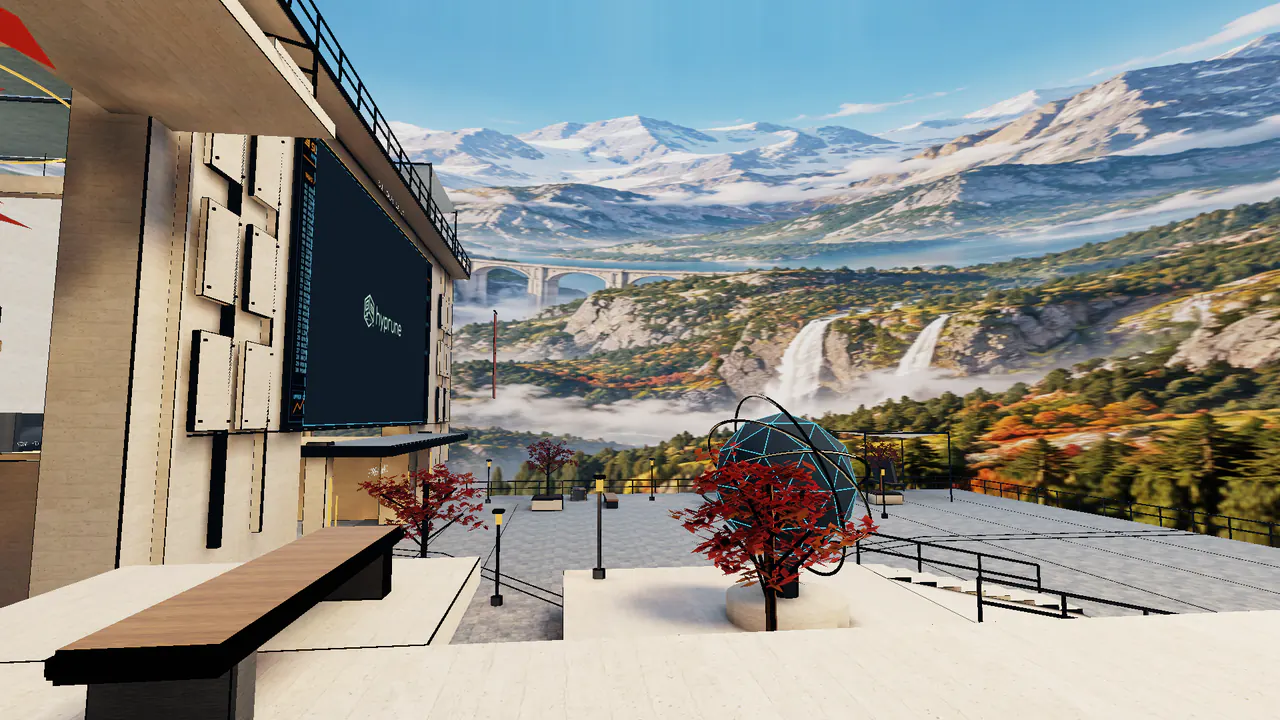
0.4.0 · first release
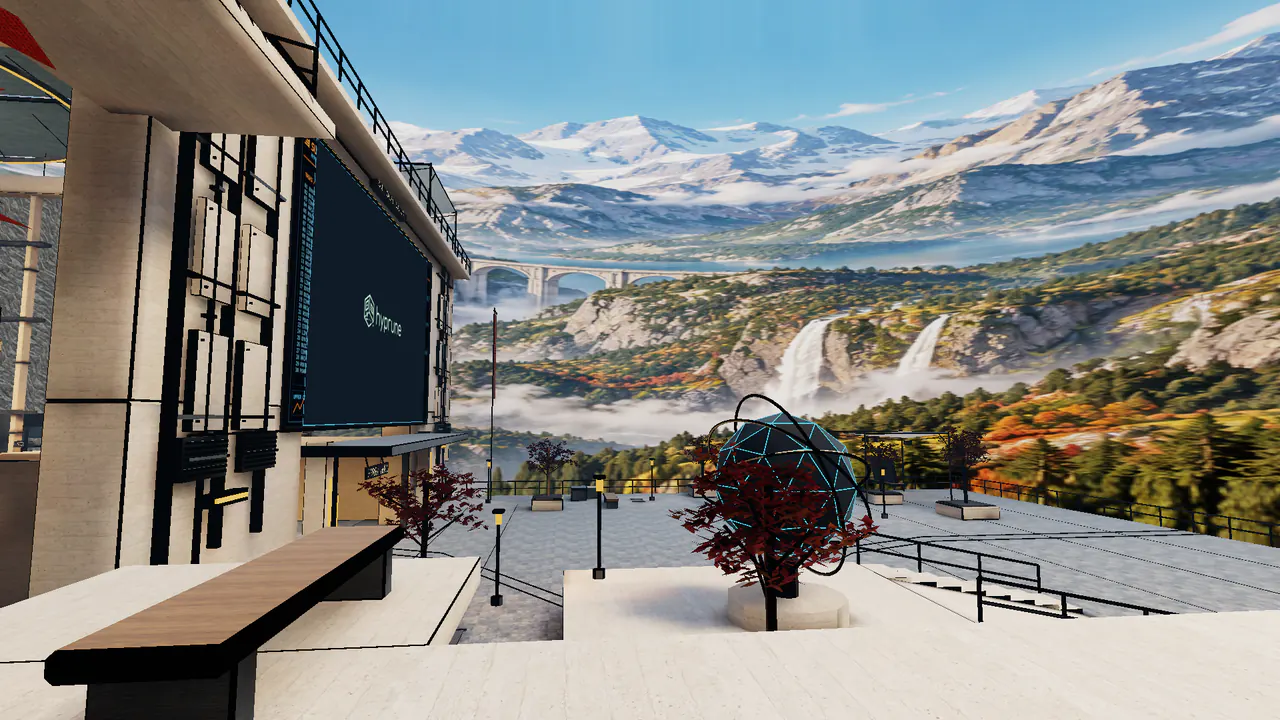
0.5.0 · facade polish
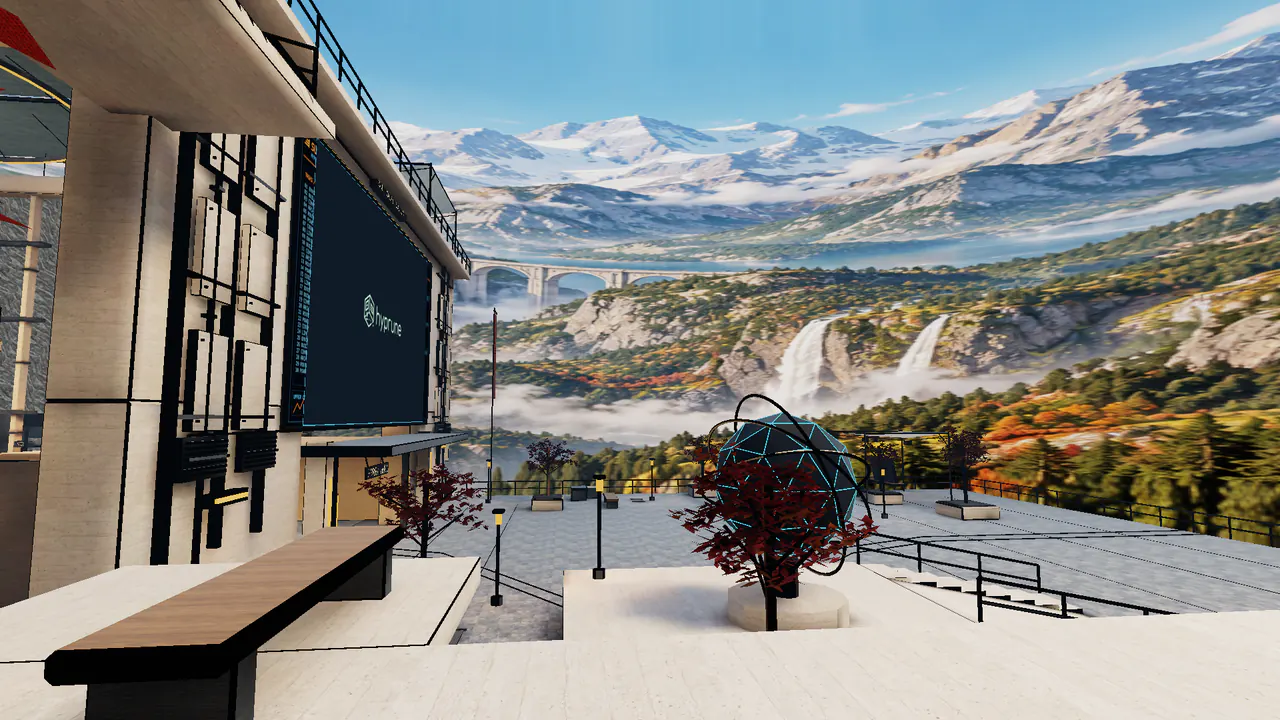
0.6.0 · unchanged here
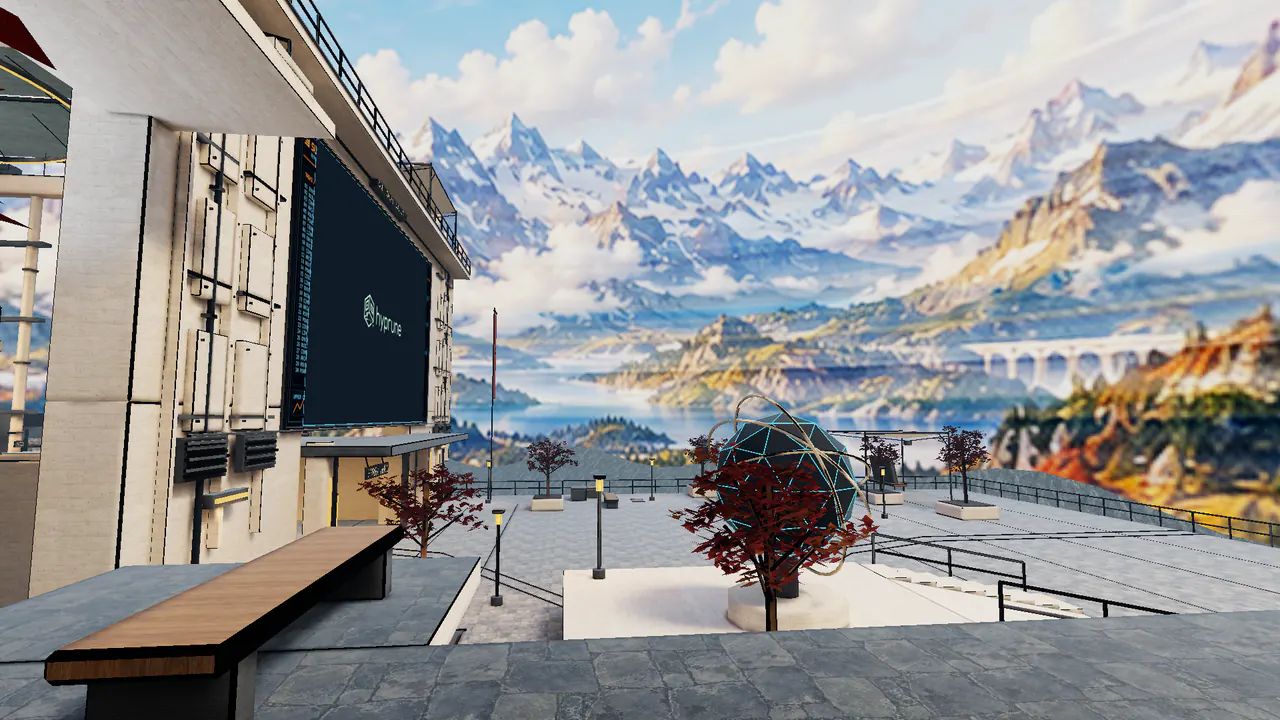
0.7.0 · closed sky dome; the panorama seam shows as ghosted peaks
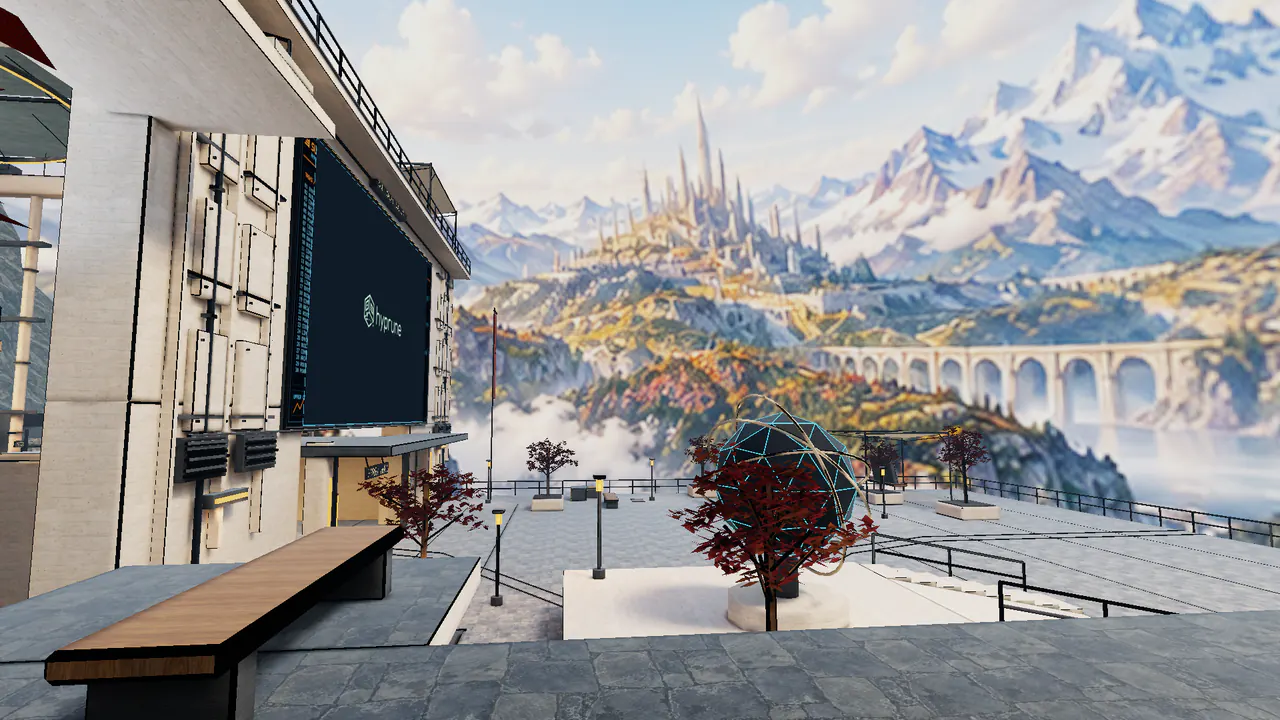
0.7.1 · repaired panorama
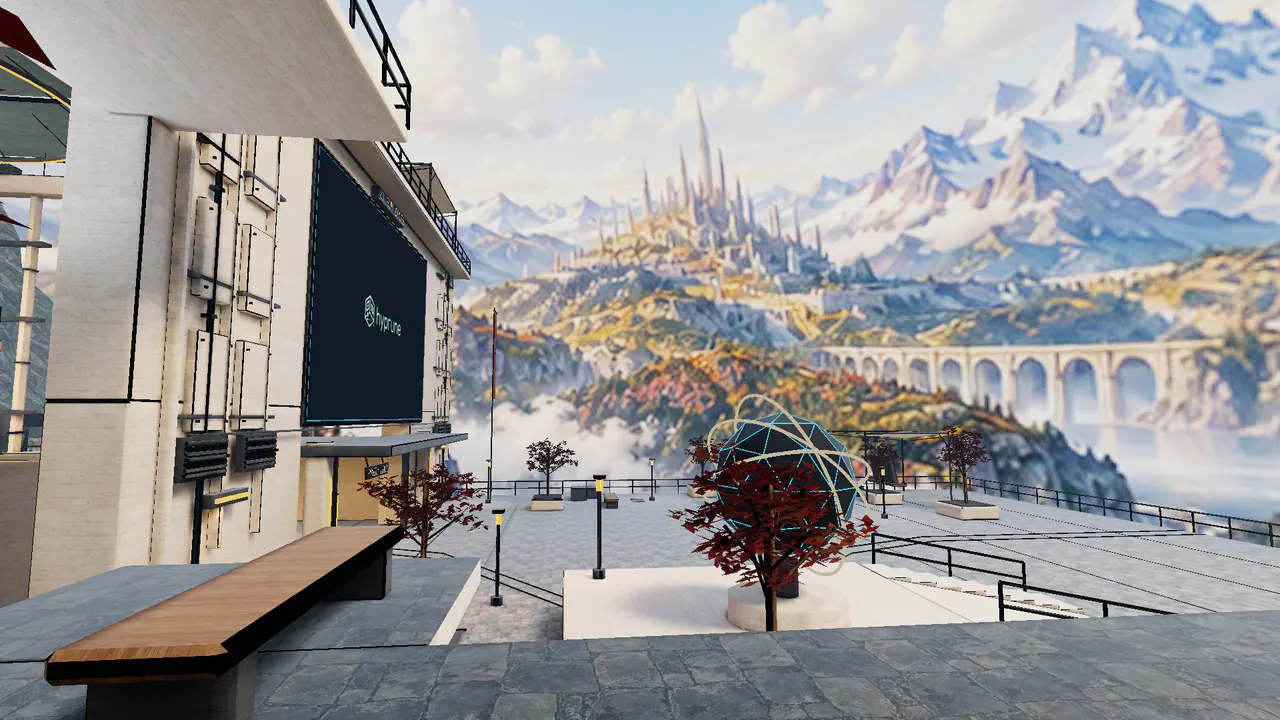
0.9.1 · current: the wall is a true 16:9 frame
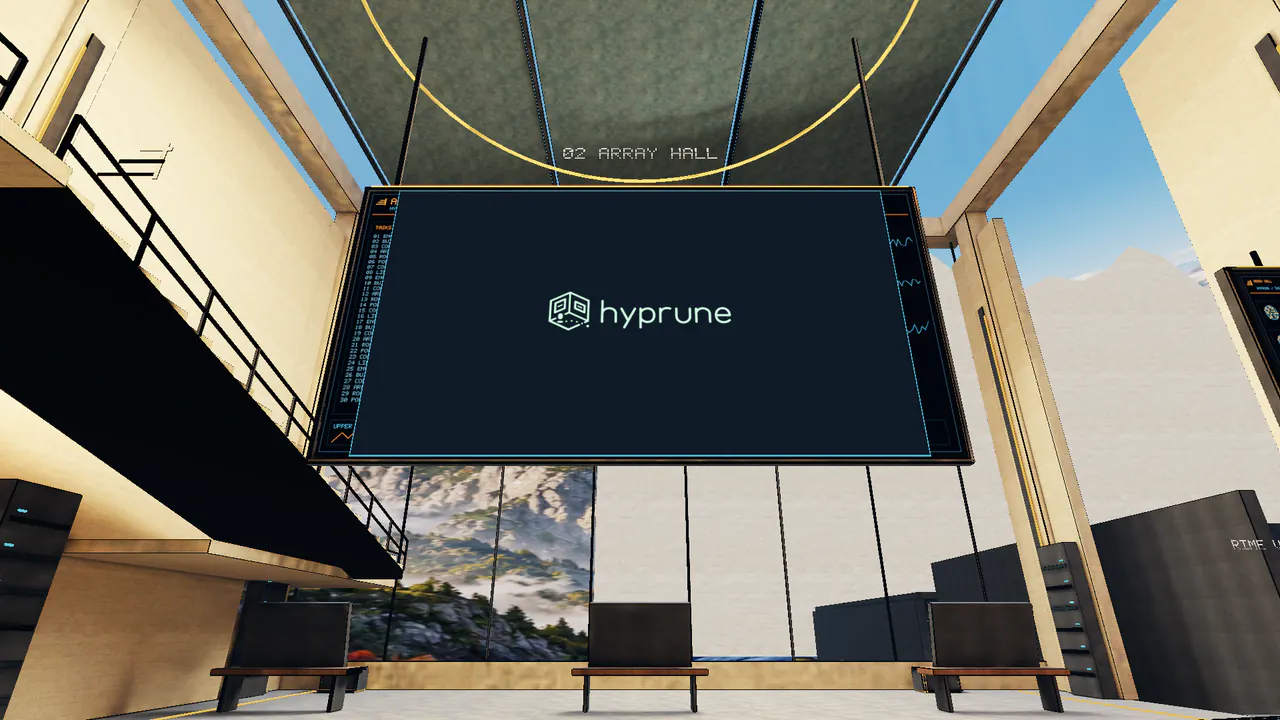
0.4.0 · first release
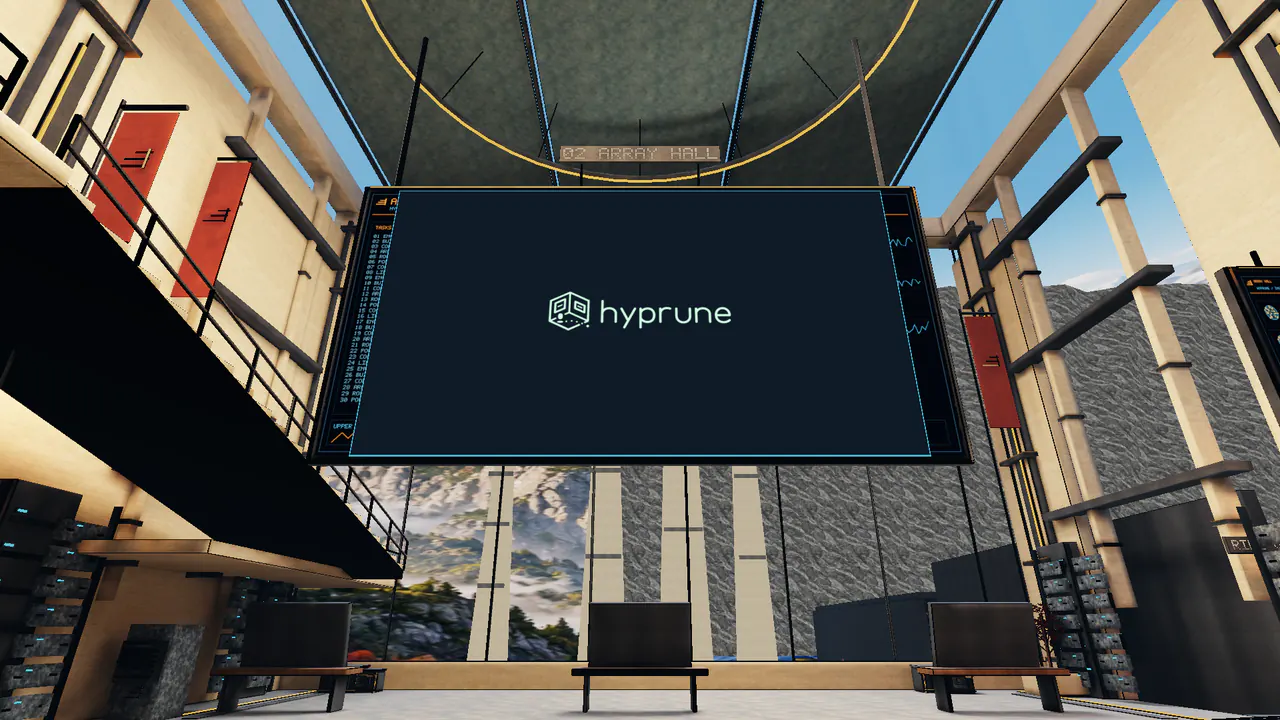
0.5.0 · banners and detail
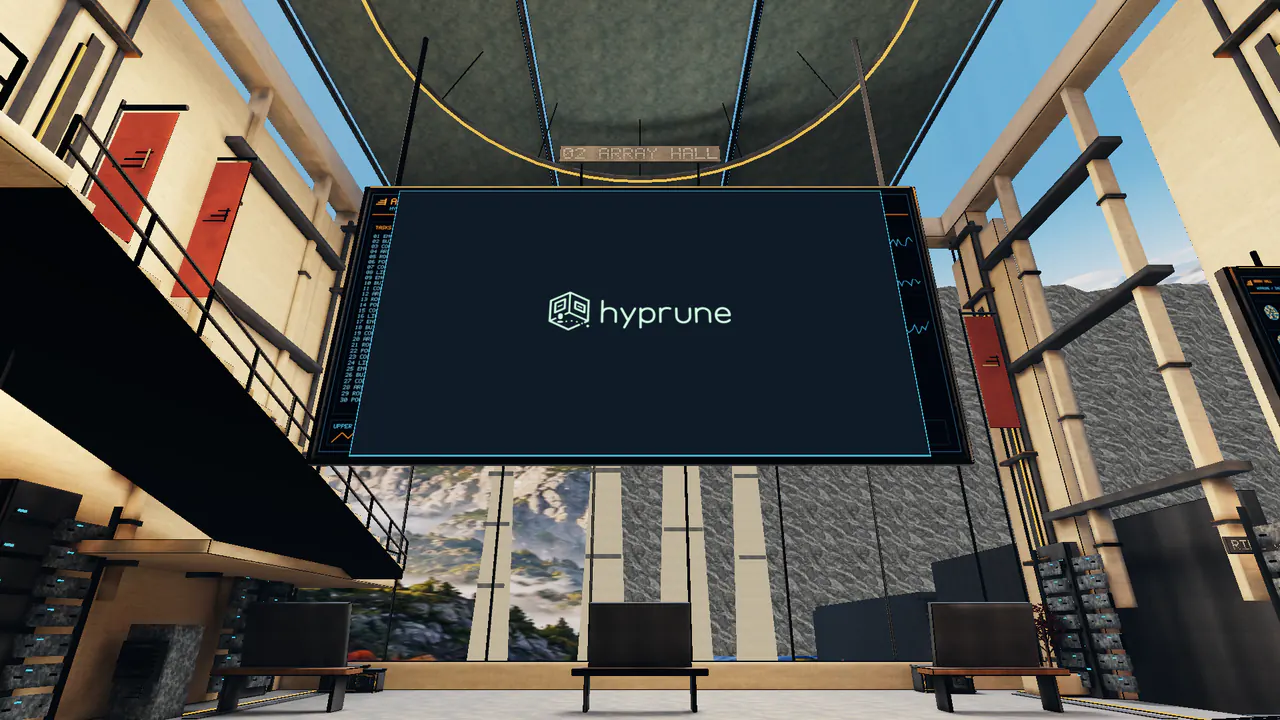
0.6.0 · unchanged here
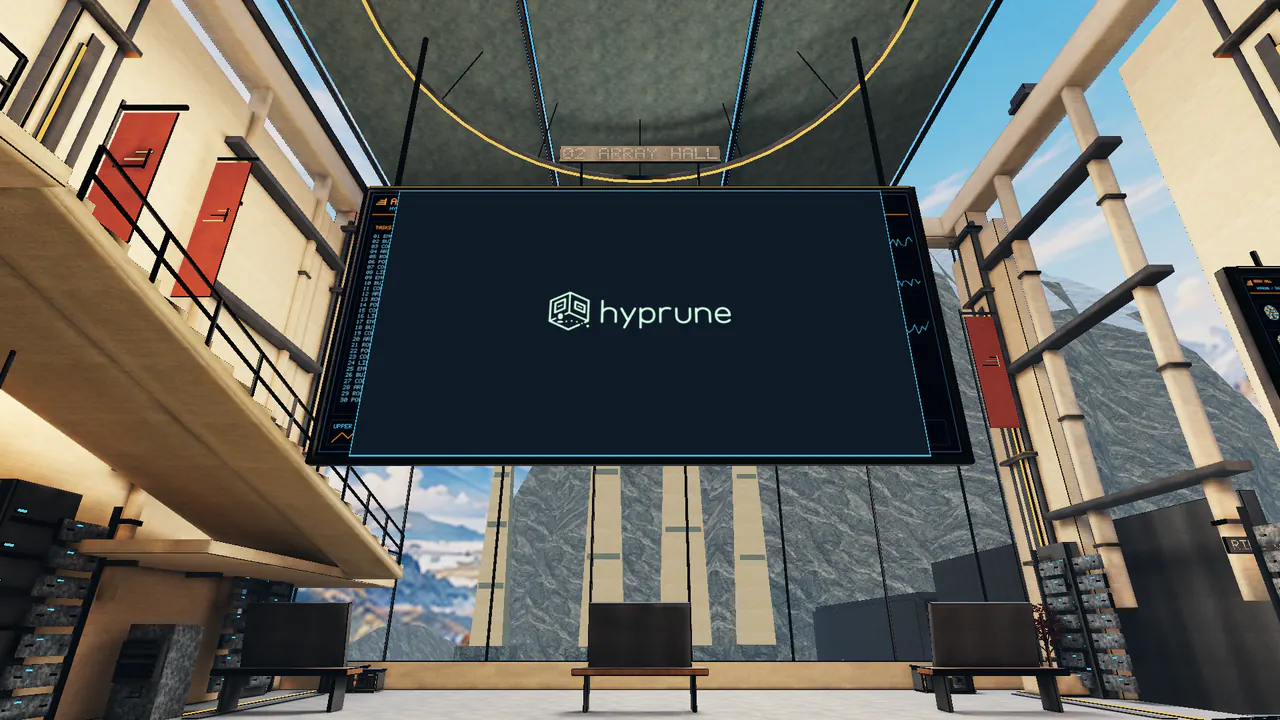
0.7.0 · a new sky beyond the glass
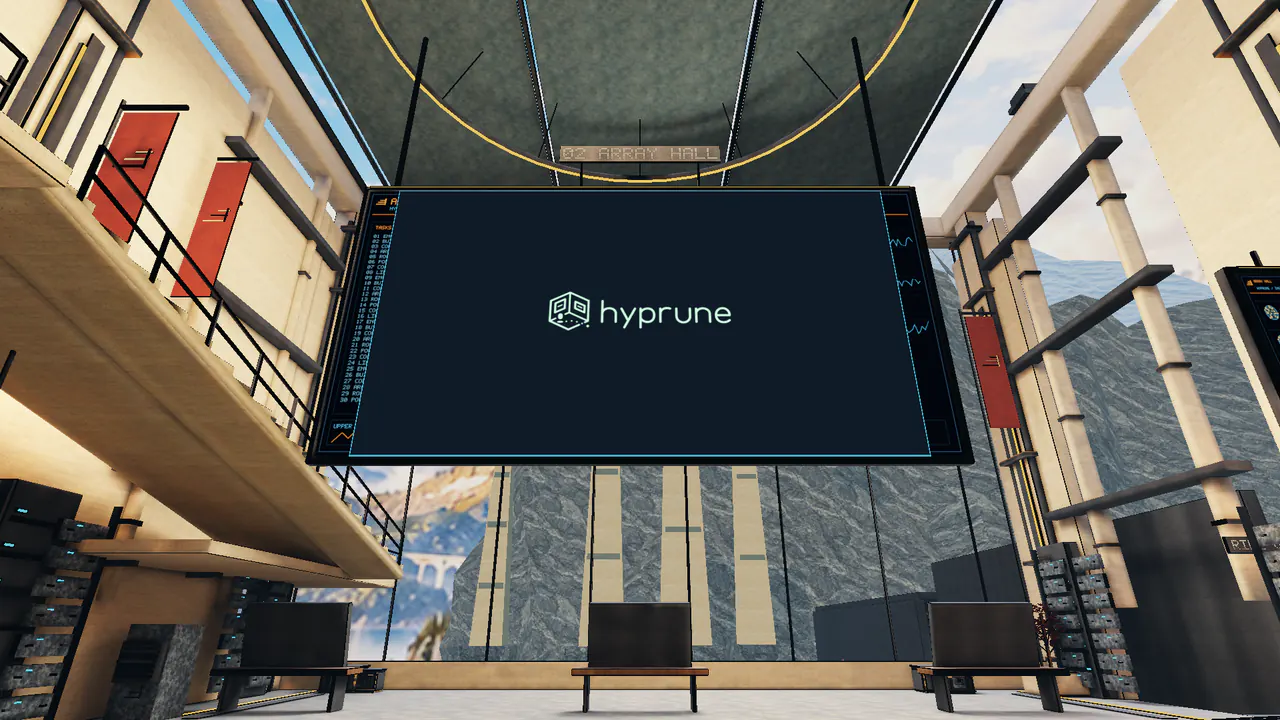
0.7.1 · unchanged here
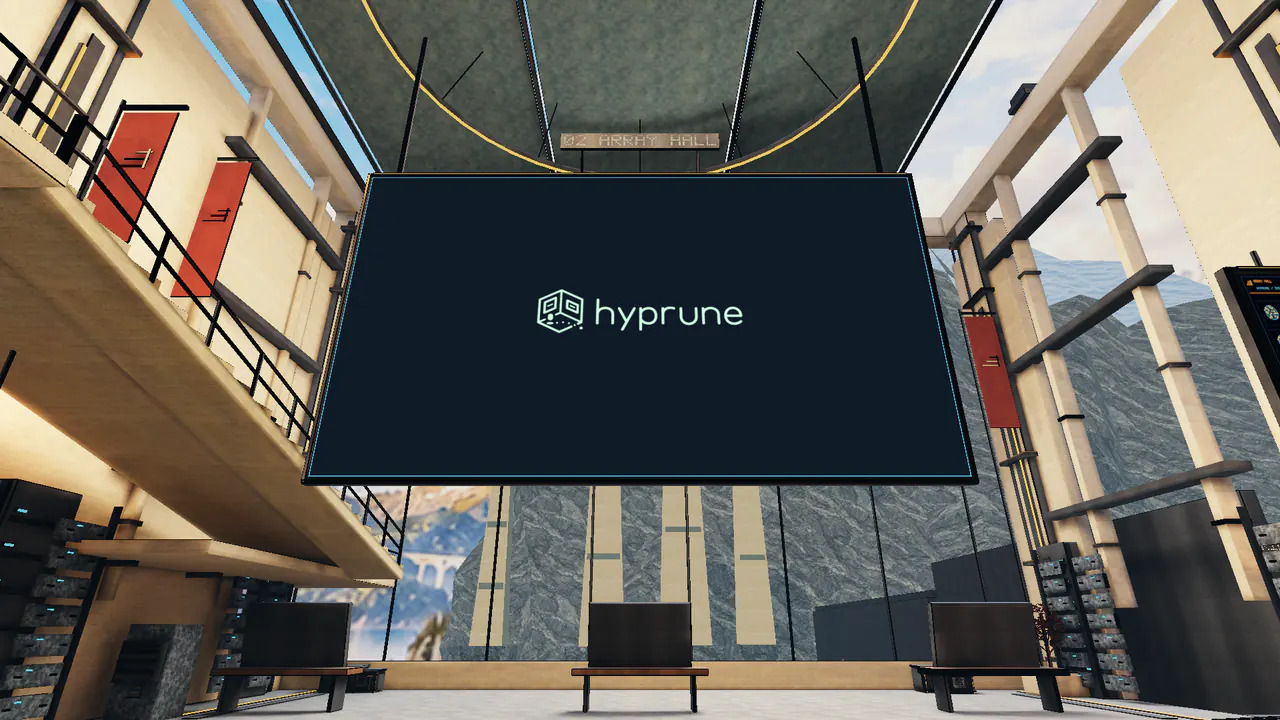
0.9.1 · current: a 16:9 wall frame
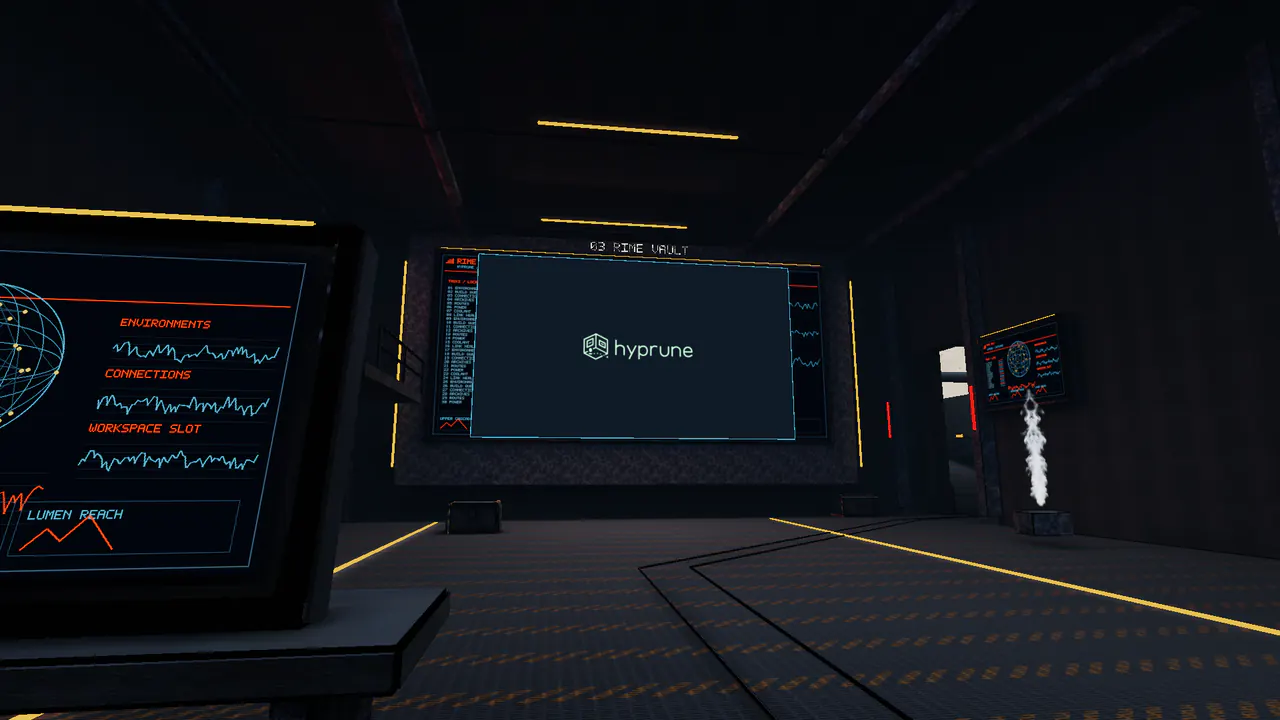
0.4.0 · first release
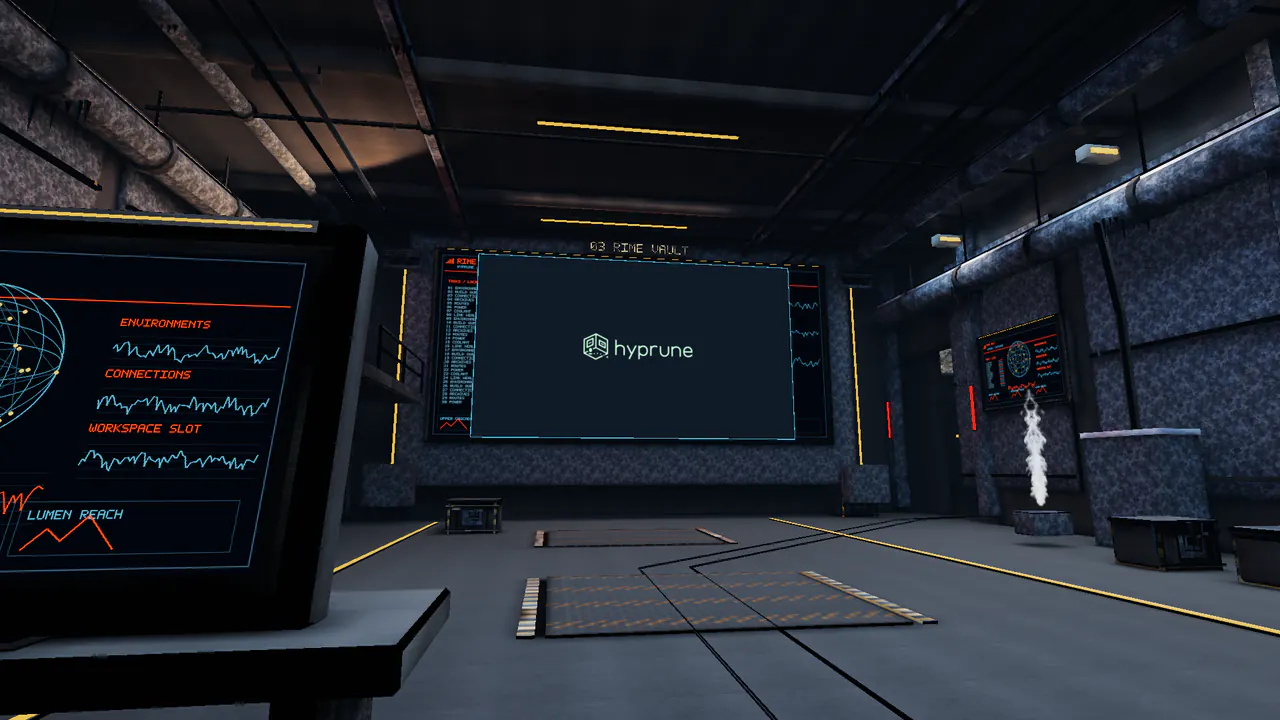
0.5.0 · lighter walls
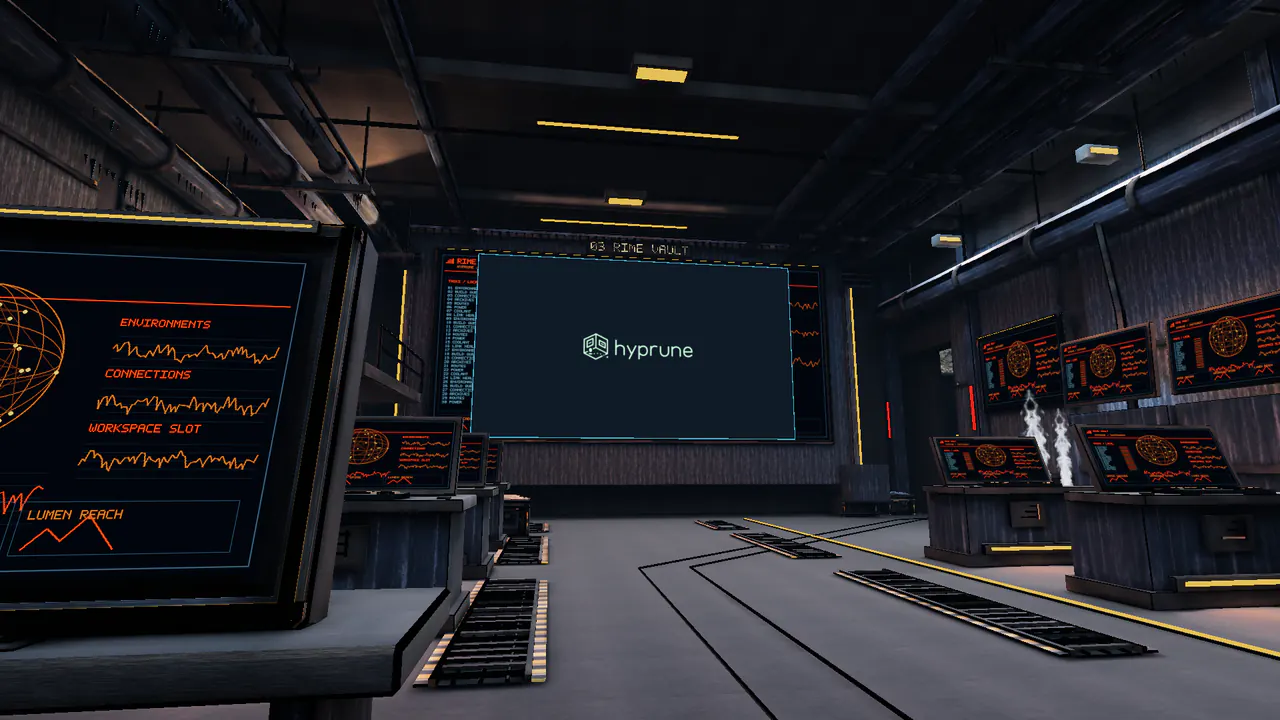
0.6.0 · frost pass: console banks and cable grates
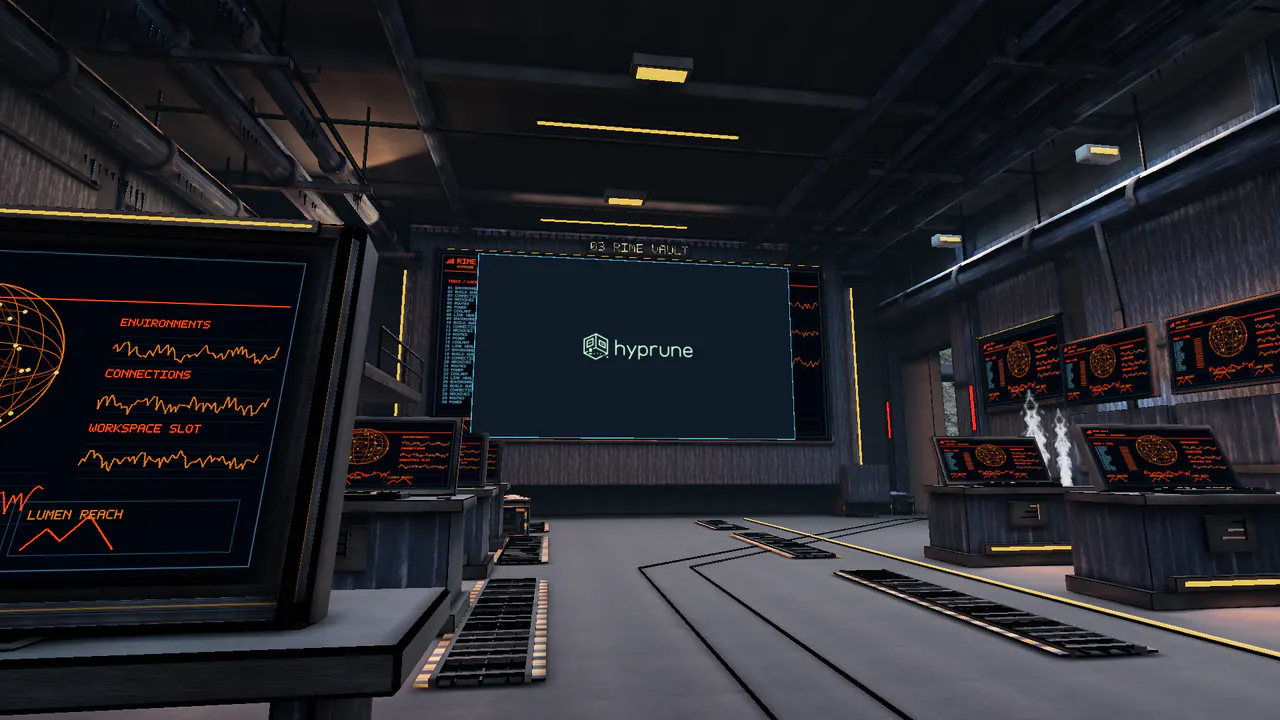
0.7.0 · little change here
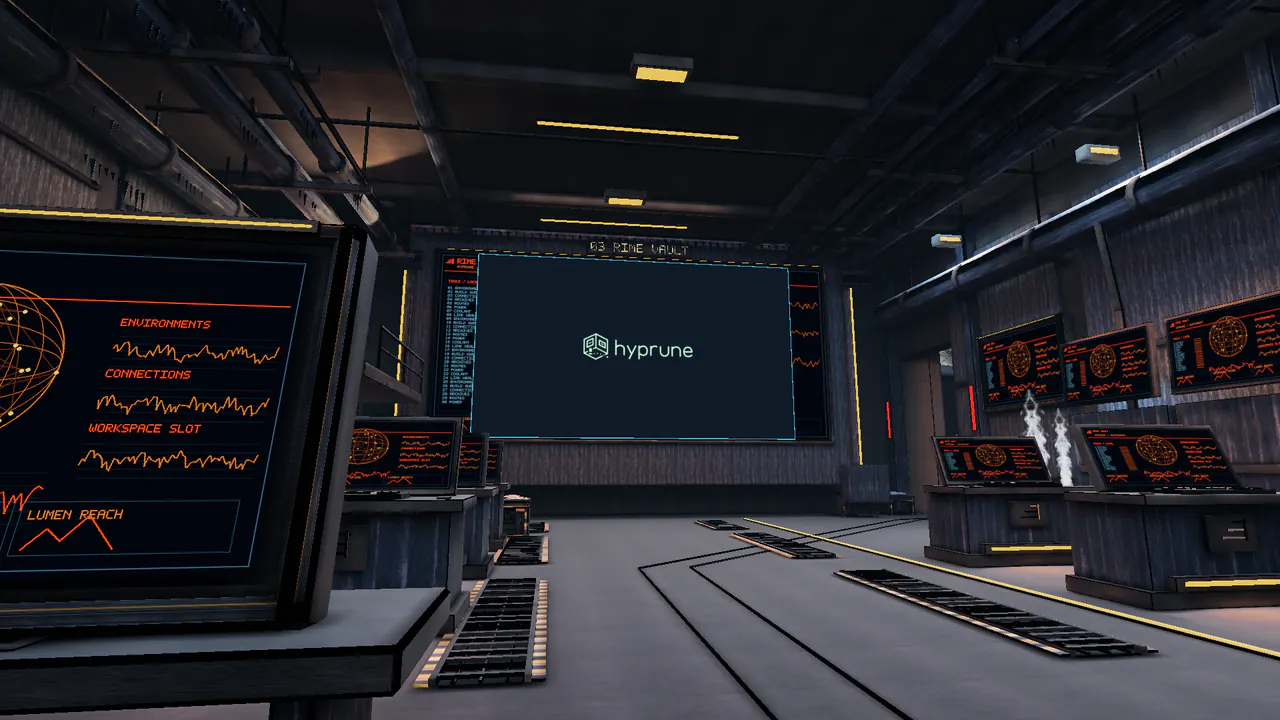
0.7.1 · unchanged here
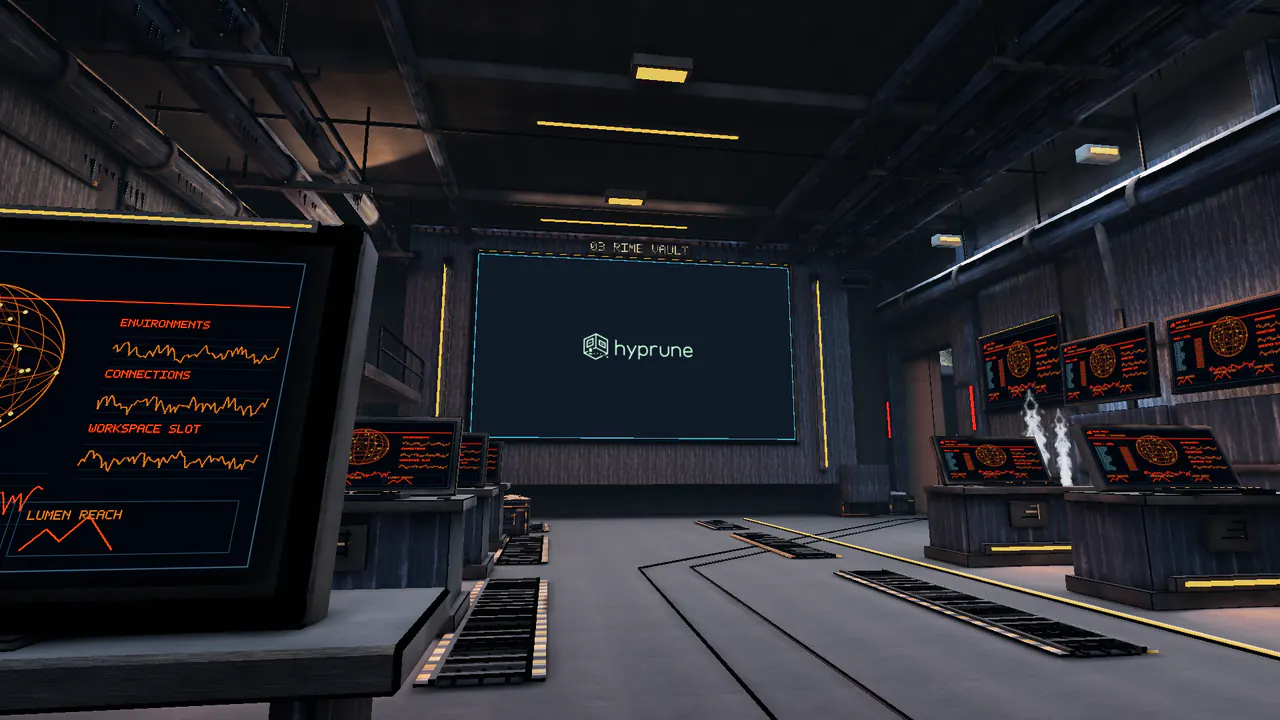
0.9.1 · current: a 16:9 wall frame
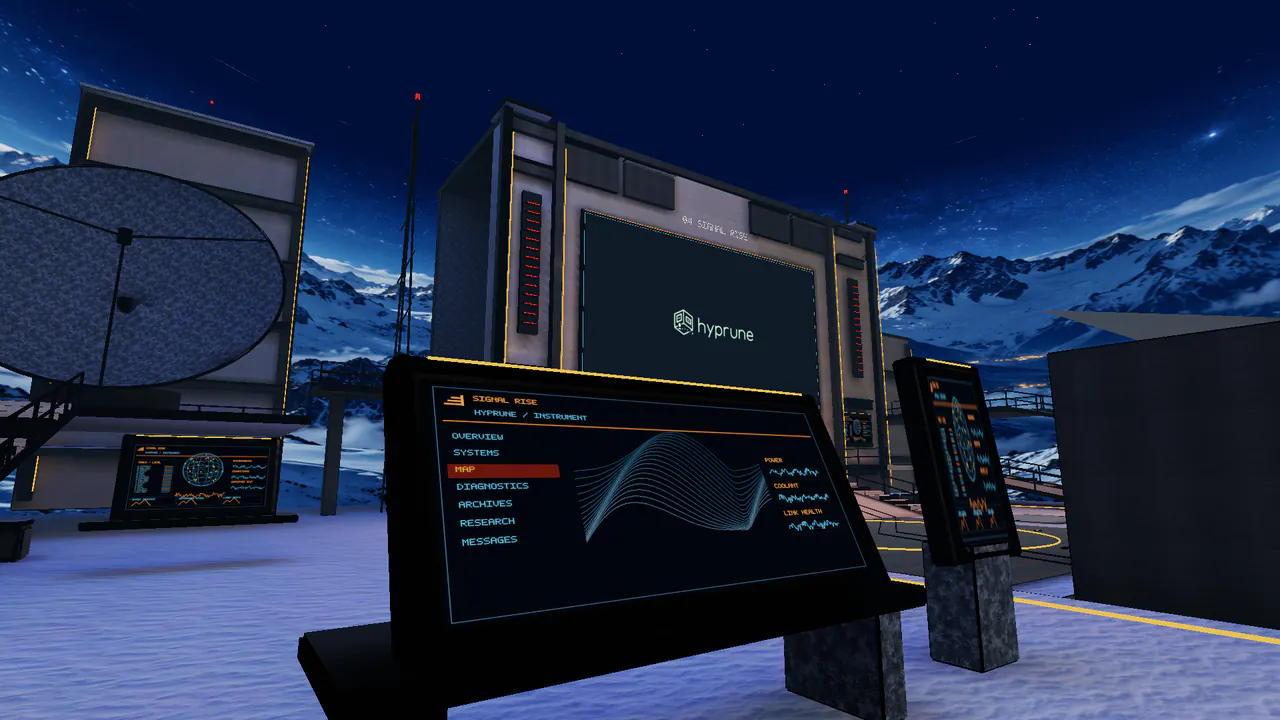
0.4.0 · first release
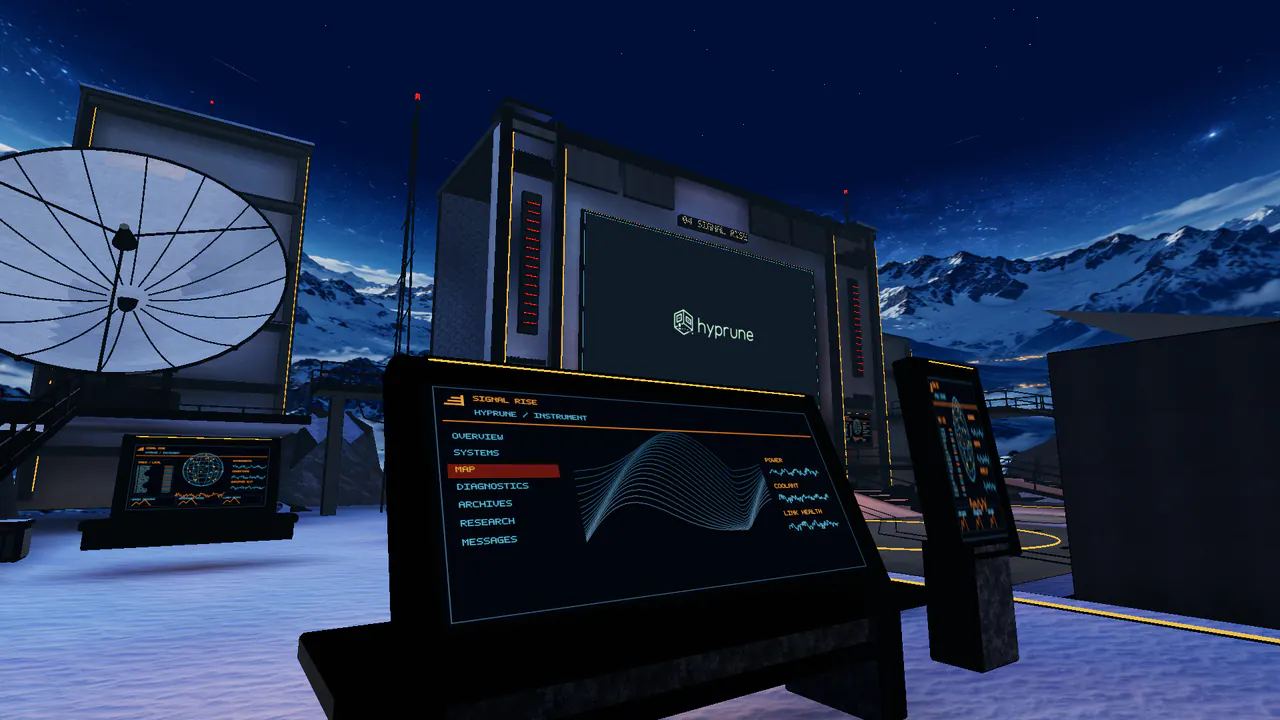
0.5.0 · the dish and more detail
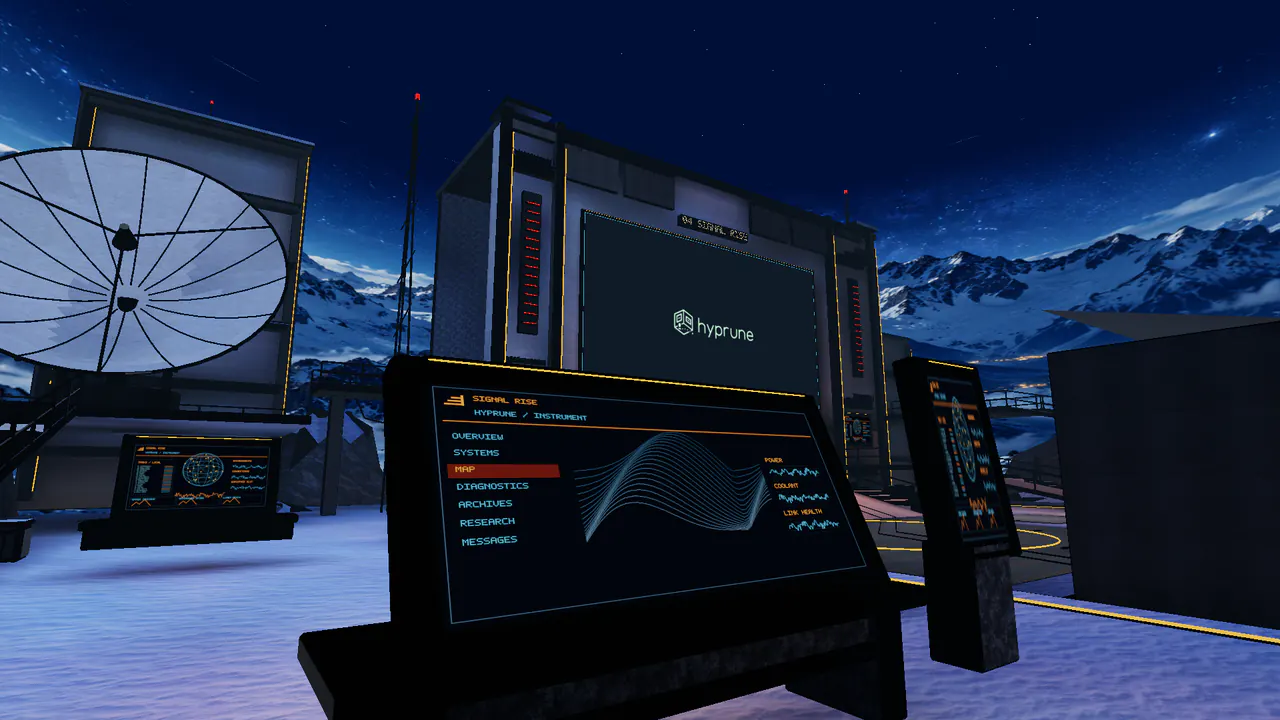
0.6.0 · unchanged here
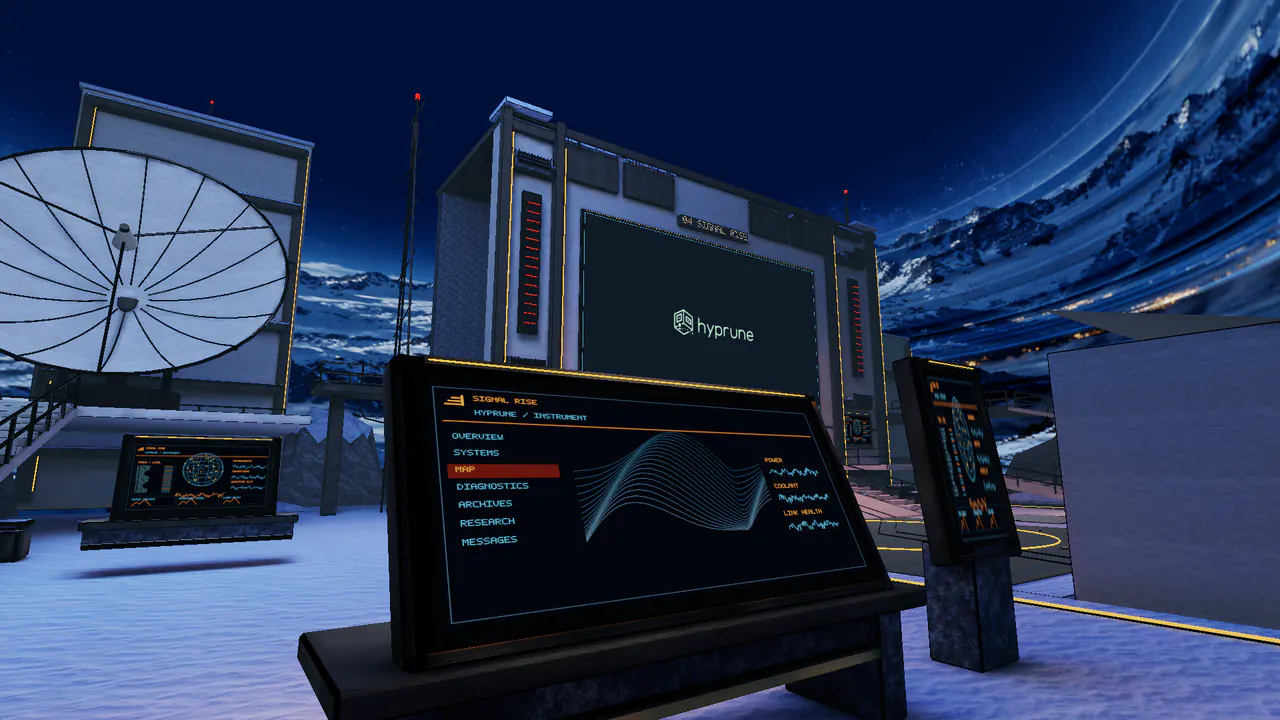
0.7.0 · closed sky dome
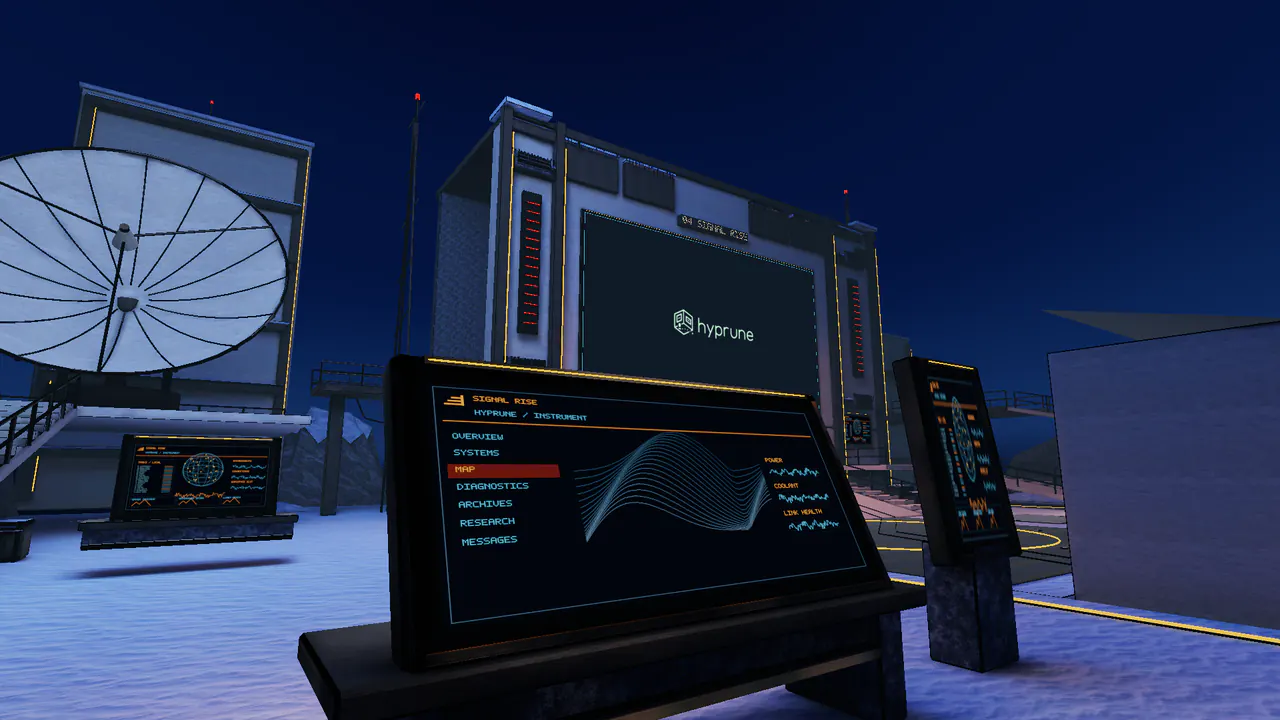
0.7.1 · a smooth night sky
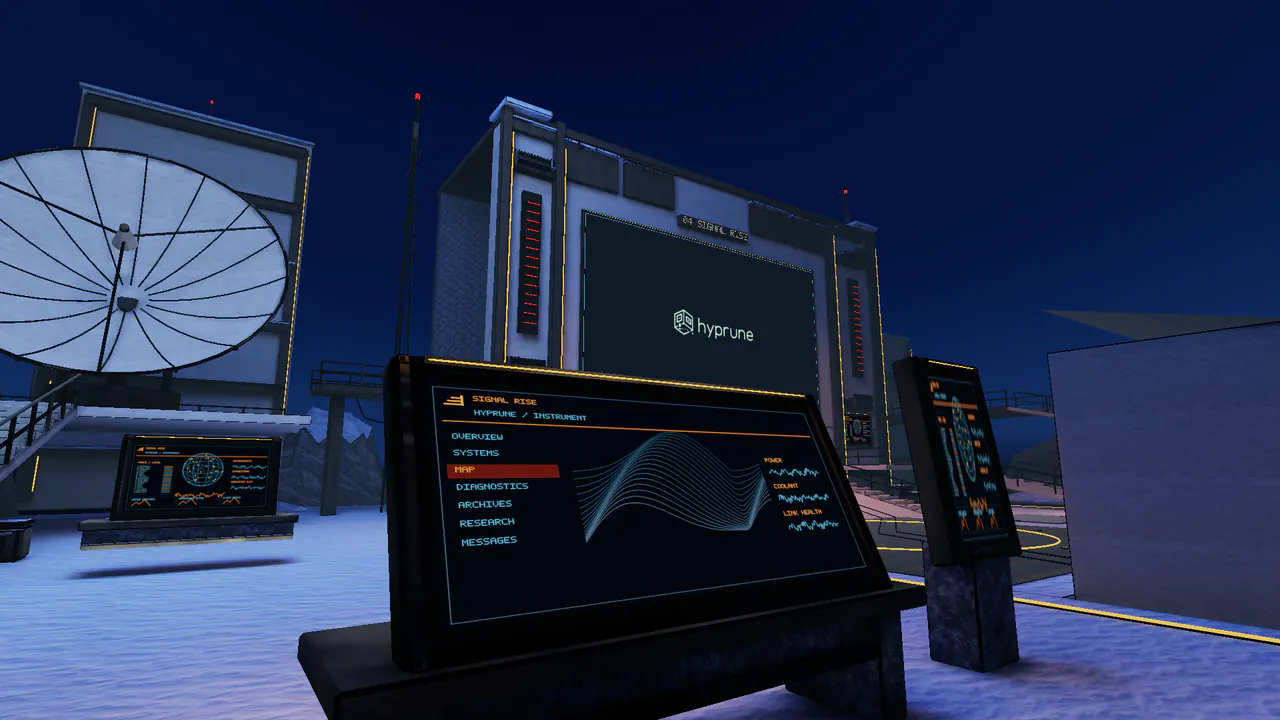
0.9.1 · current: a 16:9 wall frame
The four homes in 0.9.1
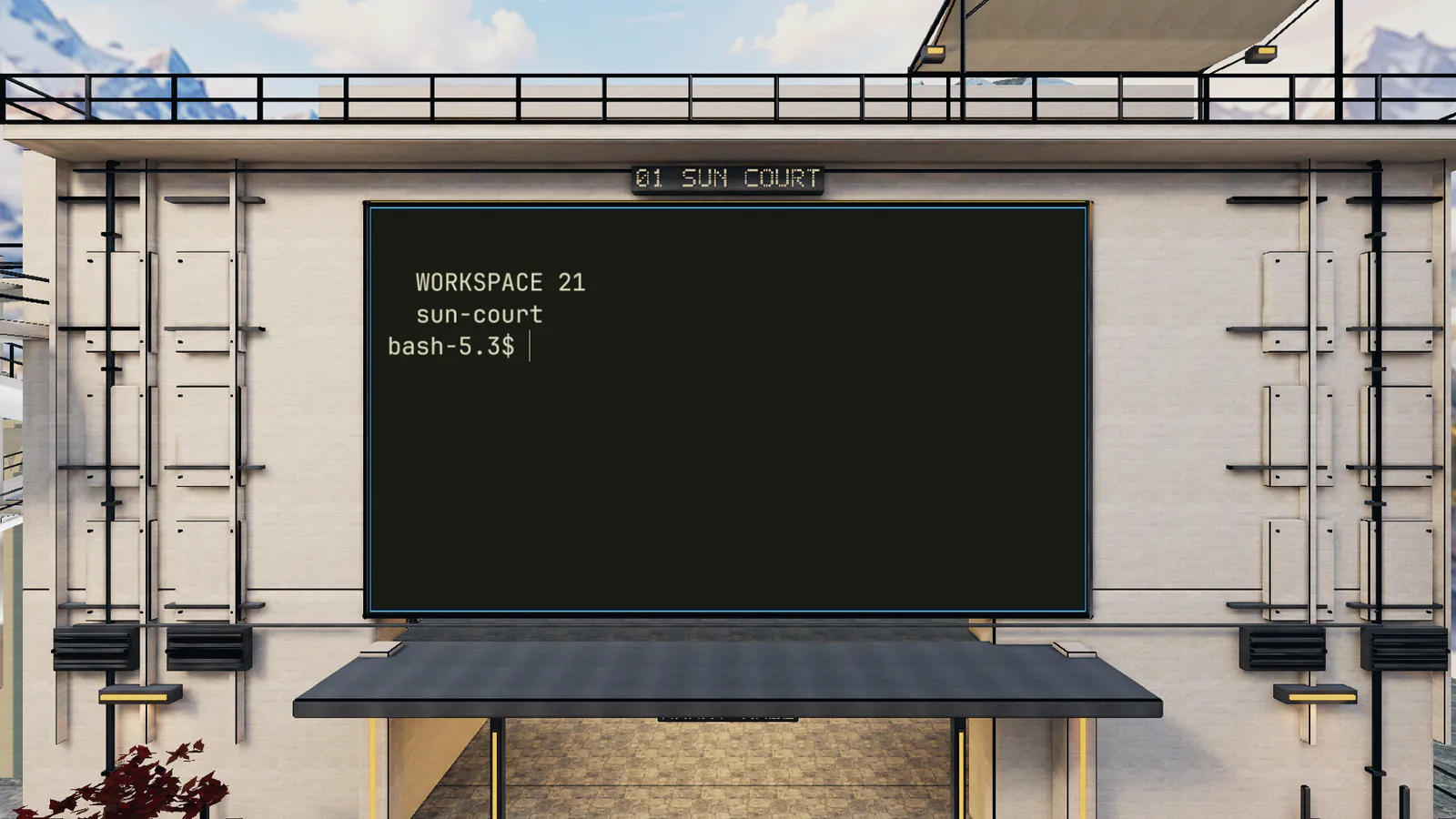
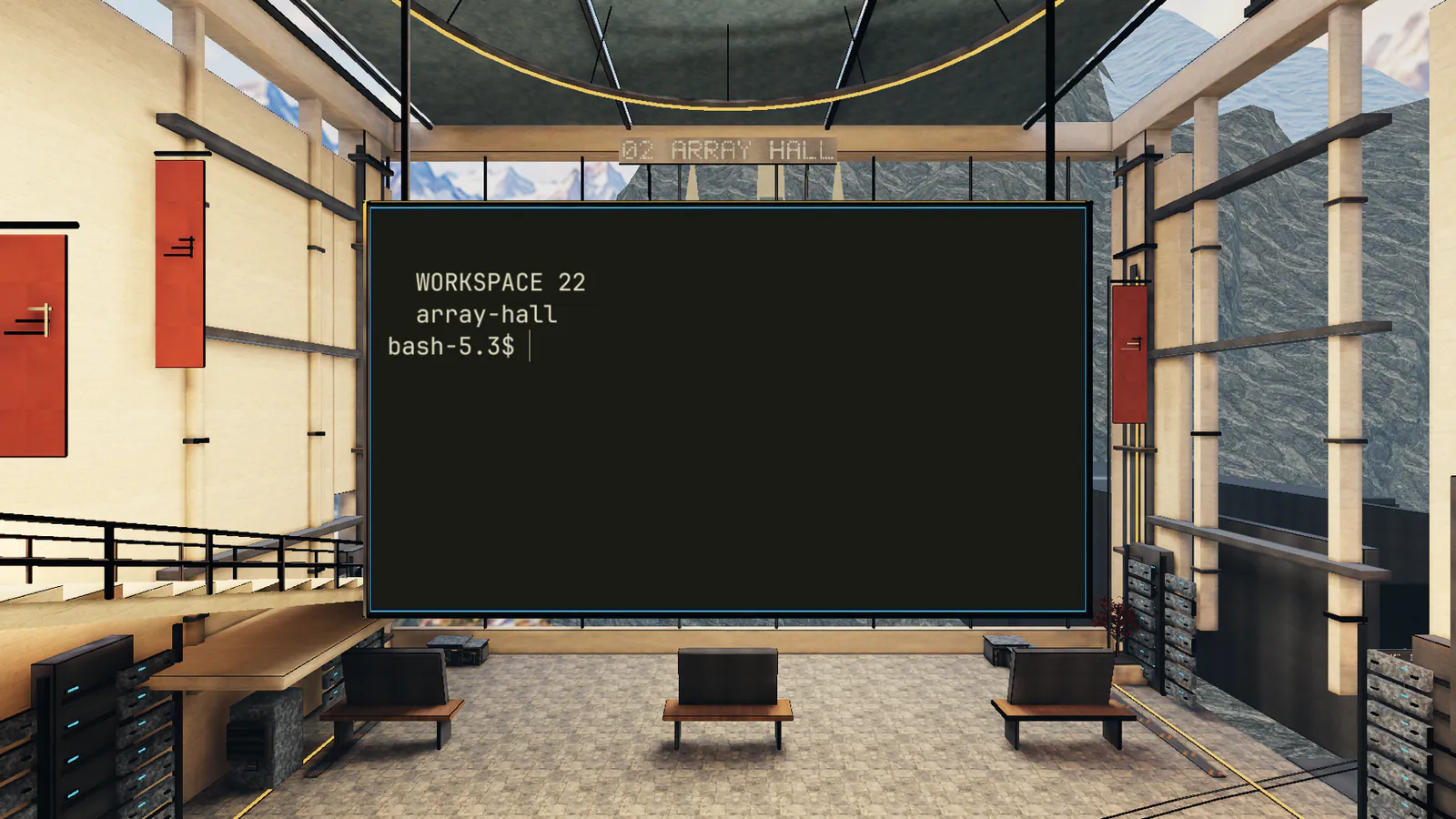
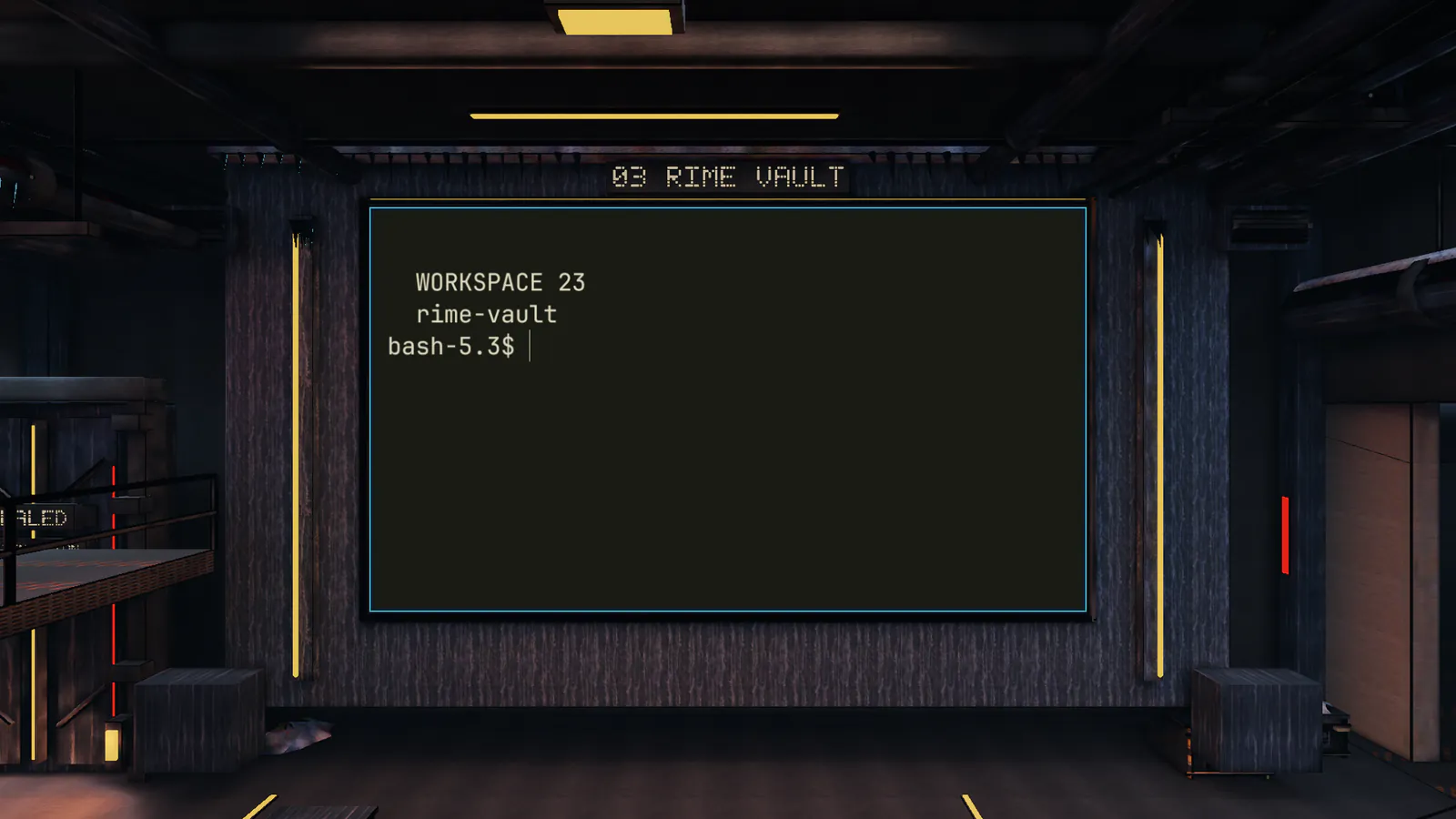
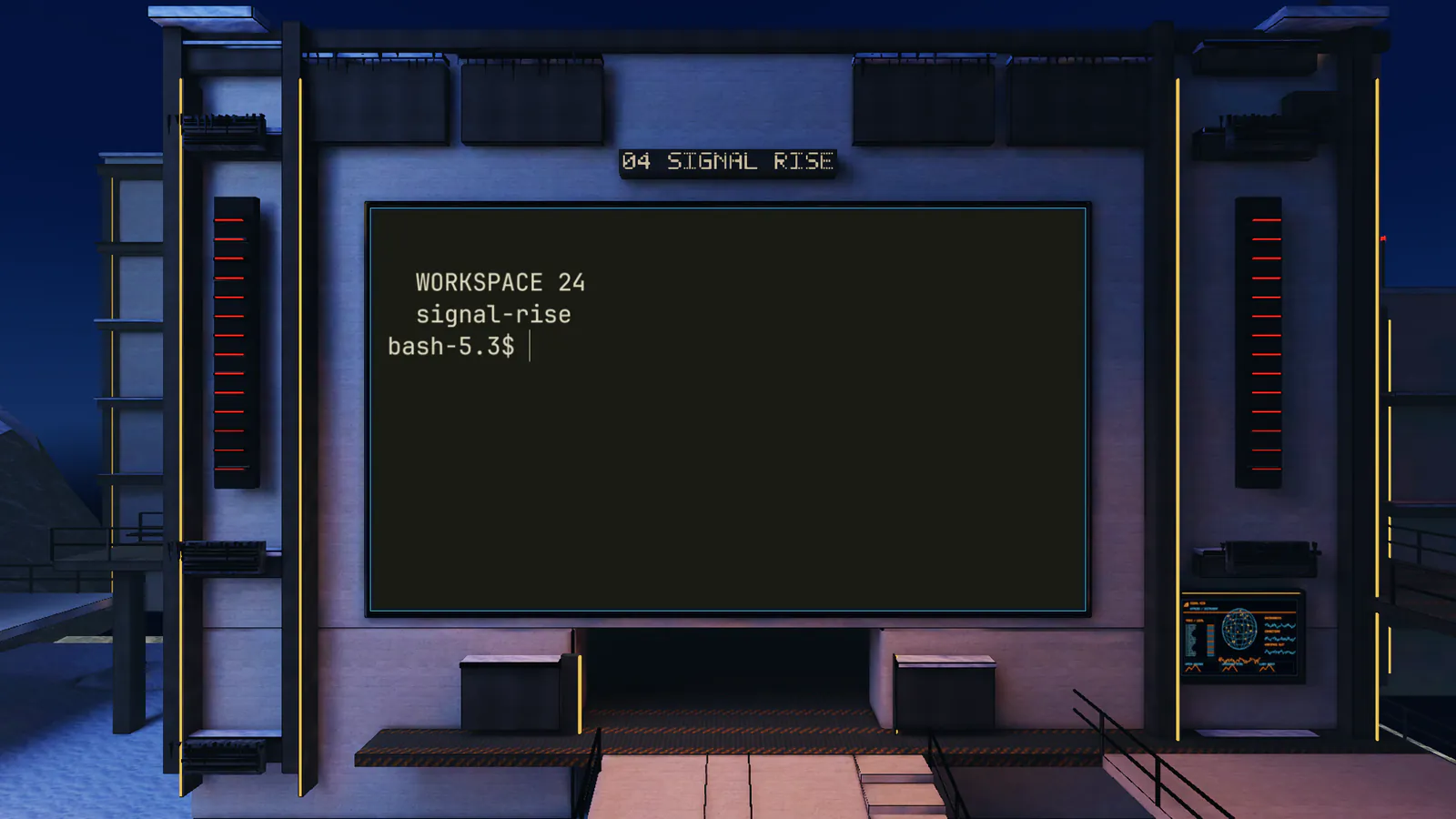
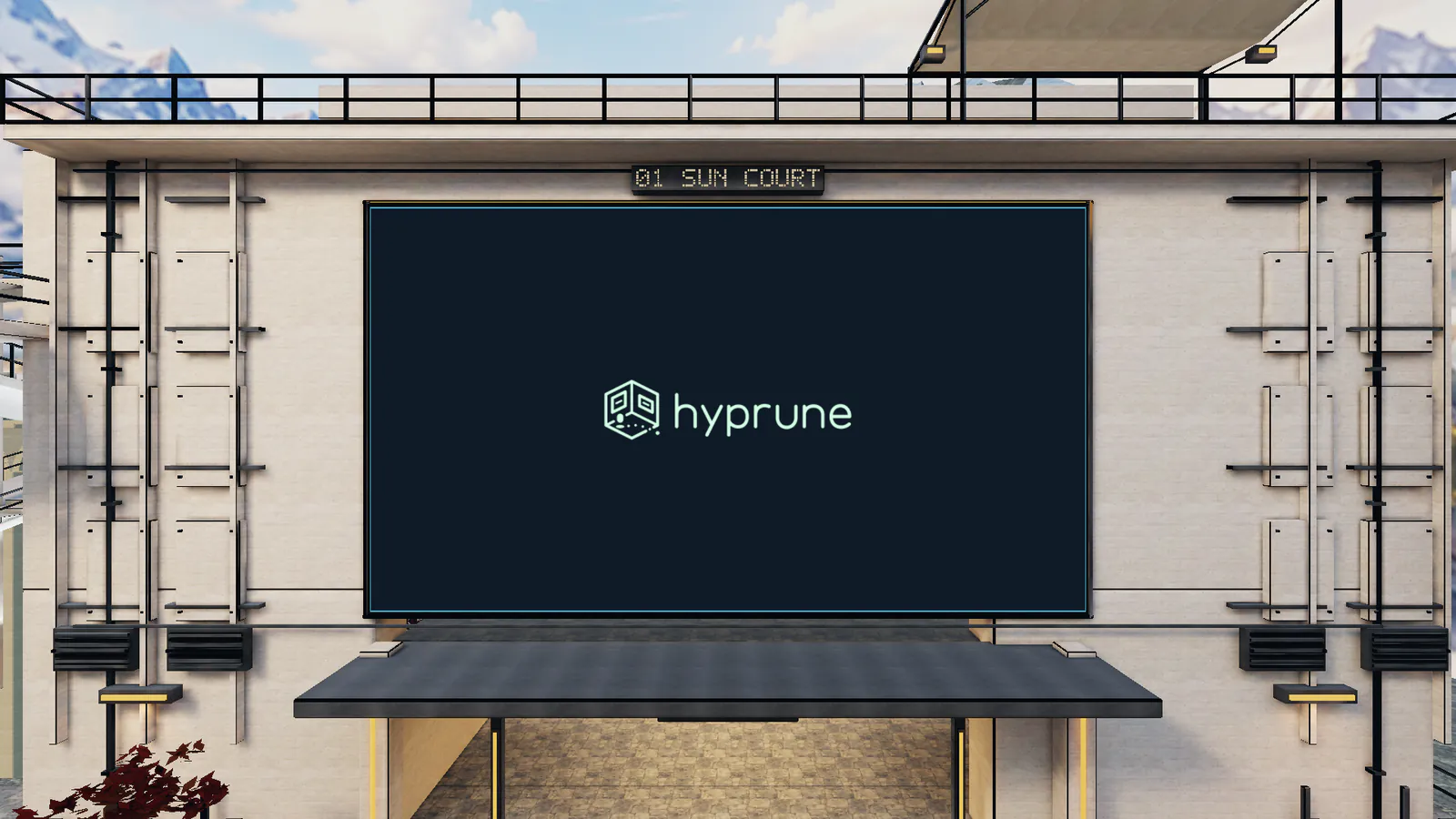
Section titled “The four homes in 0.9.1”Since 0.9.1 each primary wall is a true 16:9 frame, so a workspace fills it edge to edge. Here each home’s wall shows its own workspace (21 to 24) with a terminal open. A wall with no windows shows your wallpaper or, as at Sun Court below, the Hyprune placeholder.
Releases
Section titled “Releases”| Release | Published | Format | Archive | Triangles | GPU memory | What changed |
|---|---|---|---|---|---|---|
| 0.12.0current | 15 Oct | 0.9 | 55.4 MB | 261,060 | — | Residents who sit like people: the starter motions’ upright sit, retargeted onto each resident by core 0.10.0; same frame times and budgets as 0.11.3 |
| 0.11.3 | 14 Oct | 0.9 | 53.8 MB | 261,060 | — | Nowhere to fall out of the world: the slot at the Signal Rise stair foot is floored, and every floor edge with nothing below it is guarded; a fall-through sweep with the walker is now a release gate. |
| 0.11.2 | 14 Oct | 0.9 | 53.9 MB | 260,356 | — | The valley: the painted panorama continues into the terrain below the settlement, with no horizon seam; rock cliffs under the plinths. |
| 0.11.1 | 13 Oct | 0.9 | 53.4 MB | 242,820 | — | Fixes from live testing: no more flickering tiles, decks and beams where surfaces met flush, no drain pipe stubs on the roof, the valley below the edges in daylight instead of black, and residents stop in front of the screens |
| 0.11.0 | 13 Oct | 0.9 | 52.7 MB | 245,458 | — | Residents: one per area on authored routes with stops, benches and short lines; Crimson marks the way to Rime Vault and Ember guides you to Signal Rise |
| 0.10.3 | 12 Oct | 0.8 | 39.4 MB | 245,062 | — | The Sun Court plaza is plain paving: the dark expansion seams and the bent inset route rails are gone (1,492 fewer visible triangles, same draw calls). |
| 0.10.2 | 12 Oct | 0.8 | 39.5 MB | 246,554 | — | Array Hall's new enclosure walls take the hall's own detailing: the south wall gains the side walls' ribs, trim collars and dark metal lintels, with the main screen bay recessed so its approach stays clear. |
| 0.10.1 | 11 Oct | 0.8 | 39.5 MB | 245,582 | — | Array Hall is an enclosed hall: walls on the east, south and west rise into the roof beams, with doors where routes pass; the north panorama stays the open view. |
| 0.10.0 | 11 Oct | 0.7 | 39.2 MB | 251,506 | — | The Sun Court armillary is now a placed world object: the globe turns slowly and its three rings spin, matched to the 0.9.2 look (per-region colour difference under 1 ΔE). |
| 0.9.2 | 11 Oct | 0.7 | 39.3 MB | 251,506 | 150 MiB* | The same world as 0.9.1, rebuilt so its shipped images carry no build metadata; all checks pass with unchanged budgets |
| 0.9.1 | 11 Oct | 0.7 | 39.3 MB | 251,506 | 150 MiB* | Fixes from live testing: the four primary walls are true 16:9 frames, signs clear the roofs, rails on the rooftop walkway, bridge and raised landings, a terrain shading fix |
| 0.9.0 | 10 Oct | 0.7 | 39.7 MB | 245,330 | 150 MiB* | Visibility derived at build time (184 visibility areas); per-area playable volumes with a 60 m fly ceiling; backstops only where a walker can reach; canonical areas contract |
| 0.8.1 | 10 Oct | 0.7 | 39.7 MB | 245,330 | 150 MiB* | Closes a Rime Vault ceiling slot that showed sky; the build now fails on sky leaks through enclosure roofs and walls |
| 0.8.0 | 10 Oct | 0.7 | 39.4 MB | 245,330 | 150 MiB* | First release on world format 0.7: KTX2 textures, meshopt geometry and lightmap mips; same look and frame time |
| 0.7.2 | 9 Oct | 0.5 | 46.8 MB | 245,330 | 373 MiB | A walkable, clear roof route |
| 0.7.1 | 9 Oct | 0.5 | 46.9 MB | 244,526 | 373 MiB | Fixes from the first live walk: sky seam, a capped stair, the night sky |
| 0.7.0 | 9 Oct | 0.5 | 47.9 MB | 244,312 | 373 MiB | Closed sky dome and mountain basin; flight passes over the perimeter; 56-view any-angle sweep and full route traversal |
| 0.6.1 | 9 Oct | 0.5 | 45.2 MB | 222,403 | 326 MiB | Moves to world format 0.5: authored visibility regions for every home |
| 0.6.0 | 8 Oct | 0.2 | 45.2 MB | 222,403 | 326 MiB | Rime Vault frost and density pass |
| 0.5.0 | 8 Oct | 0.2 | 38.5 MB | 199,911 | 286 MiB | Visual polish in every home; about 60 frames/s per home at Medium on an Intel iGPU at 4K |
| 0.4.0 | 8 Oct | 0.2 | 34.5 MB | 210,067 | 272 MiB | First release: Sun Court, Array Hall, Rime Vault and Signal Rise, 24 mounts, routes and alternate stairs |
GPU memory is the package checker's upload estimate at full texture resolution. *From 0.8.0 on, textures stay compressed on the GPU, so the figure is core's measured upload.gpuBytes for 0.8.0; on that measure 0.7.2 uses 270.5 MiB, and later package estimates stay within 0.4 MiB of 0.8.0's. Release numbers are independent of world format versions. Table generated from the release reports; see progress-data.mjs.
Frame rate, power and memory
Section titled “Frame rate, power and memory”The test machine is a laptop with an Intel Panther Lake iGPU driving a 4K output, often on USB-C power. Every number below comes from an isolated nested session with Lumen Reach unless noted. The source documents are in the core repository.
From about 15 to 60 frames per second at 4K
Section titled “From about 15 to 60 frames per second at 4K”At native 4K with fixed full-resolution rendering, the median frame interval was 66.6 ms (about 15 FPS). Dynamic resolution brought it to a 16.7 ms median (60 FPS) on 8 October. Most of the gain came from rendering fewer pixels and cutting memory traffic, not from drawing fewer objects. A later run sustained 60.01 newly rendered frames per second for 23 seconds with zero reused frames, at automatic Low quality and a world render scale of 0.375–0.5.
Render on demand (9 October)
Section titled “Render on demand (9 October)”A world frame is rendered only when its inputs change: the camera, a window’s content or an animation. When nothing changes, the last frame is presented again.
A window updating at about 30 Hz now costs 28.9 world frames per second instead of 60. The first frame after idle took 32 ms. The memory saving comes from one colour upload, a uniform buffer, frustum culling and indexed draws.
On 10 October idle got cheaper again. Workspace walls had been recomposed on every tick even when nothing on them changed, and the default workspace homes made most area walls into such composites, so idle cost had crept up to about 2%. Walls now recompose only when their windows, popups or stacking order change:
A wall showing a live app still updates as it changes. Walls also draw windows in Hyprland’s own stacking order now, so raising a window shows on the wall too.
FSR 1 upscaling (9 October)
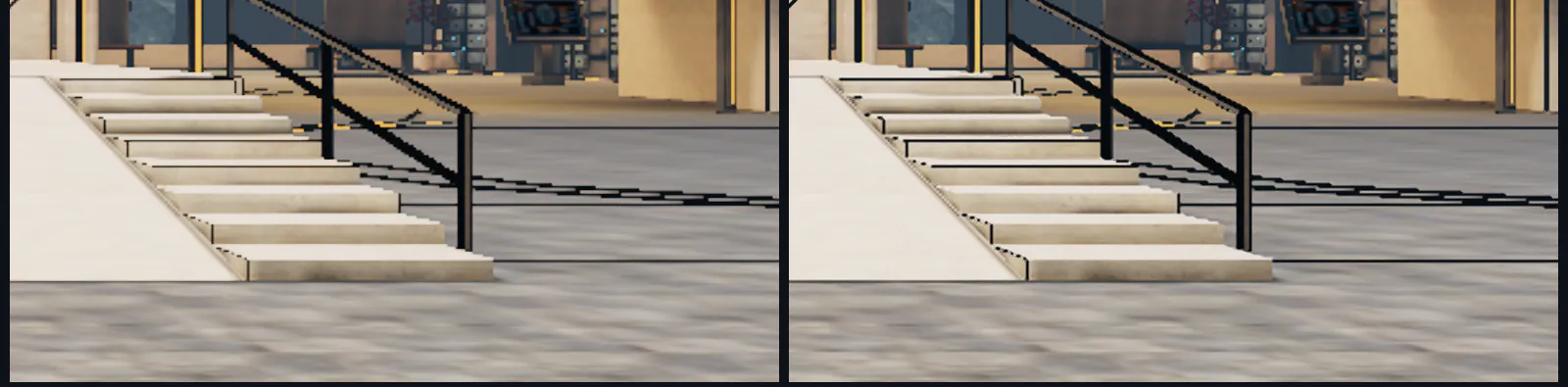
Section titled “FSR 1 upscaling (9 October)”The world renders below output resolution and is upscaled. AMD FidelityFX Super Resolution 1 (EASU + RCAS) is now the default upscaler, with bilinear plus sharpening as the fallback; since IPC 0.16 the shell’s Graphics settings can choose either. It costs about 2 ms of GPU time per frame at 0.375–0.5 scale, which dynamic resolution absorbs. It keeps edges and screen text crisper:
Compressed assets: Lumen Reach 0.8.0 (10 October)
Section titled “Compressed assets: Lumen Reach 0.8.0 (10 October)”World format 0.7 (9 October) lets packages use KTX2/Basis textures, meshopt compression and quantised meshes; lightmaps stay PNG. Lumen Reach 0.8.0 is the first release built this way. The optimiser is deterministic and a verifier checks that every manifest index, collision and UV layout survives. Measured against 0.7.2 in the same nested session (4K, Intel, Medium, fixed 0.5 scale):
The 4K Intel frame is limited by fill rate, so compression saves memory, load time and download size, not frame time. The images stay close: 36.2–41.3 dB PSNR and a mean CIEDE2000 difference of 0.53–0.87 against 0.7.2. The release build now includes a performance gate. It renders 400 poses along every route edge against the previous release and fails if median GPU time grows more than 8% or p95 more than 12%. 0.8.0 passed at +0.4% / −0.4%.
Shader work (10 October)
Section titled “Shader work (10 October)”The world shader is now compiled per effect preset, so features a preset turns off are removed at compile time instead of being skipped at run time. The stills are identical or within ±5 on a few dozen of 8.3 million pixels. Shaders also compile in parallel with the asset upload (KHR_parallel_shader_compile), so first loads stall less. Medium and above should gain less; they weren’t measured. Two other ideas were measured and dropped because they didn’t help on Intel: sorting opaque draws front to back, and blitting depth in the upscale pass.
Derived visibility (10 October)
Section titled “Derived visibility (10 October)”A new tool derives visibility regions from the navmesh and the scene, instead of authoring them by hand. On Lumen Reach it produced 160 regions in about 51 seconds. Across 64 test views and 5 targeted probes it changed no pixels, and it culled more than the hand-written regions (mean batches submitted 44.7 → 40.5). Lumen Reach 0.9.0 runs it as a build step: 805 cells merge into 184 visibility areas, and none of 29,781 eye samples hides anything it should see. Across the same 72 test views as 0.8.1, batches submitted dropped from 44.2 to 40.4, and culled frames matched unculled ones in 72 of 72 views (0.8.1: 71 of 72).
Motion feel and clarity (10 October)
Section titled “Motion feel and clarity (10 October)”Two things made moving around feel heavier than the frame rate suggested. The simulation ticked on its own 16 ms timer, which beats against the 60 Hz display, so a shown frame moved by zero, one or two steps. And when the GPU fell behind, new and repeated frames mixed at random. Now a tick runs on each presented frame, and movement and look use that frame’s real time. A frame-rate target below the display rate renders on every second (or nth) presentation, evenly. Measured in nested 4K on the Intel iGPU, with the same scripted walk and turn before and after (lower variation is smoother):
Input to first new frame stays at 8–10 ms at the default 60 FPS. A steady 30 FPS target adds one frame (22–29 ms). Two approaches were tried and dropped: interpolating between fixed steps, which made walking worse, and automatic slowdowns, which let the GPU clock down and never recover.
Workspace walls used to be composed into a fixed 1280×720 texture, which a large wall magnified almost three times at a normal viewing distance. Walls with windows are now composed at the monitor’s own resolution with mipmaps, and sampled with trilinear and anisotropic filtering. They are regenerated only when the windows change, and cost about 44 MB per wall at 4K.

Starting a carry on a window seen from behind used to stall the compositor for about 239 ms, because the turn-around sweep tested every world triangle at every step. With a broad phase and the world’s collision index, it now takes 0.16 ms. Other small changes the same day: world geometry is static to gestures and tools; a window carried from behind turns to face you; empty walls show the wallpaper or a placeholder; placed windows snap into tool-mount frames; and render-pass tracking recovers when the compositor skips the end of a pass.
View bob and the reticle (10 October)
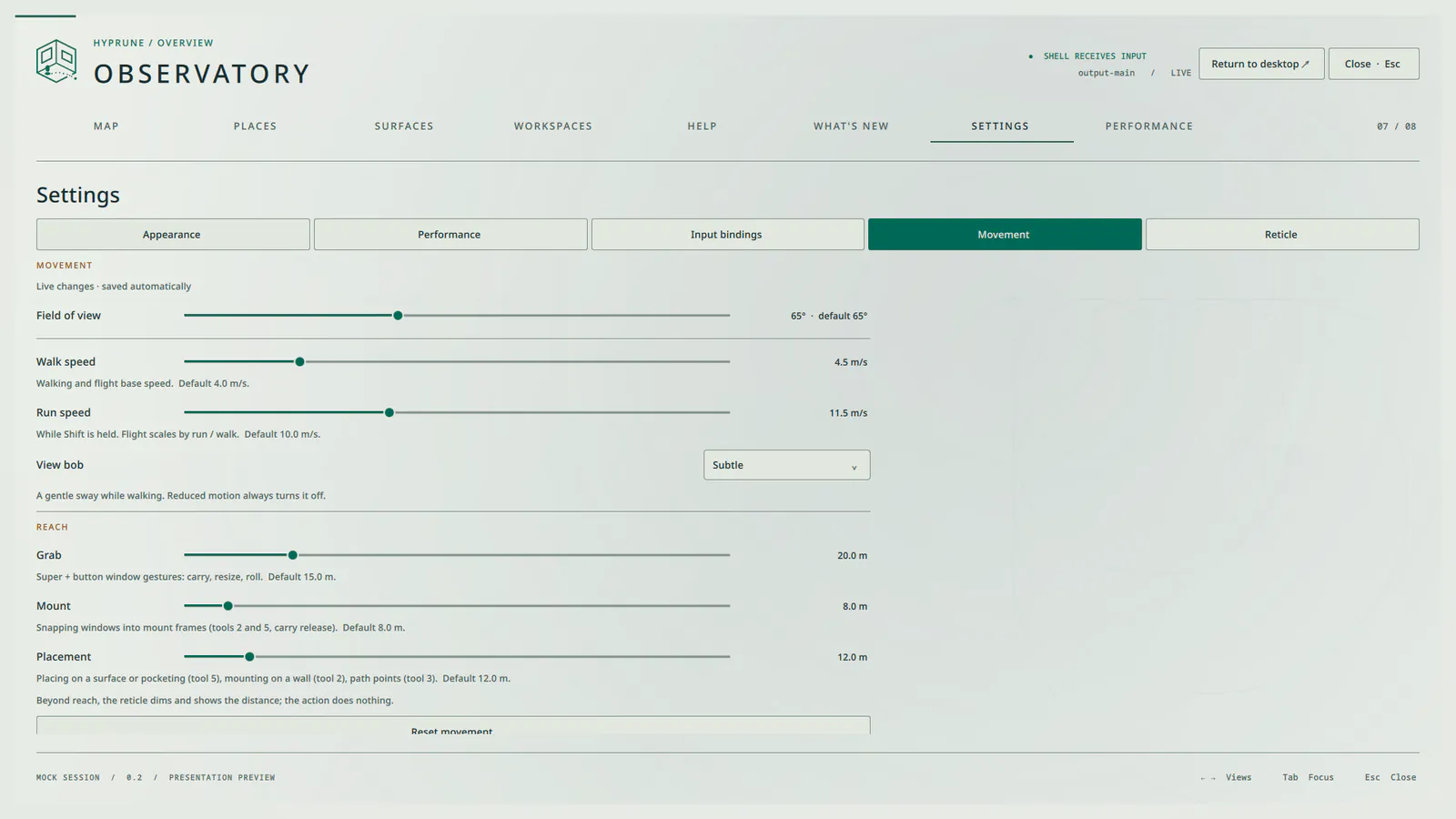
Section titled “View bob and the reticle (10 October)”IPC 0.19 adds player settings for field of view (default 65°), walk and run speed (4 and 10 m/s), reach limits and the reticle. View bob is subtle by default: one smooth 1.0 cm dip per footstep at a walking 1.9 Hz, cut to 30% at 2.5 Hz when running. It never rises above standing height, so it can’t poke through a low ceiling. It is off in flight, noclip, climbing, typing and scripted driving, and always off with reduced motion. It is view-only, so picking, the reticle and recordings never see it. Measured at 4 m/s, the dip peaks at 0.68–0.98 cm and settles to exactly zero within 1.6 s of stopping.
The reticle has six styles. It opens up while you move and shows what the current tool would do: valid, out of reach (with the distance) or invalid. Every state changes shape as well as colour.
Fixes from testing (10–11 October)
Section titled “Fixes from testing (10–11 October)”Most of 10 October’s work came from walking the release world on real hardware and replaying what testers captured:
- World geometry is static: tools and gestures can no longer nudge a building.
- A window can be carried from behind; it turns to face you. Starting that carry stalled the compositor for 234–239 ms because the turn-around sweep tested every triangle at every step. A broad phase and the world’s collision index bring it to 0.15–0.17 ms.
- An empty workspace wall shows your wallpaper, or a Hyprune placeholder, instead of a black panel.
- A window released over a tool mount snaps into its frame, which highlights first.
- Windows that already exist when a world loads take their authored docks instead of waiting in the pocket.
- A tester’s capture showed black specks on a roughness-1 surface on Intel. Replaying the capture pose in a nested session traced them to invalid values in the world shader. With guards in place, black pixels at that pose dropped from 7,800 to 5.
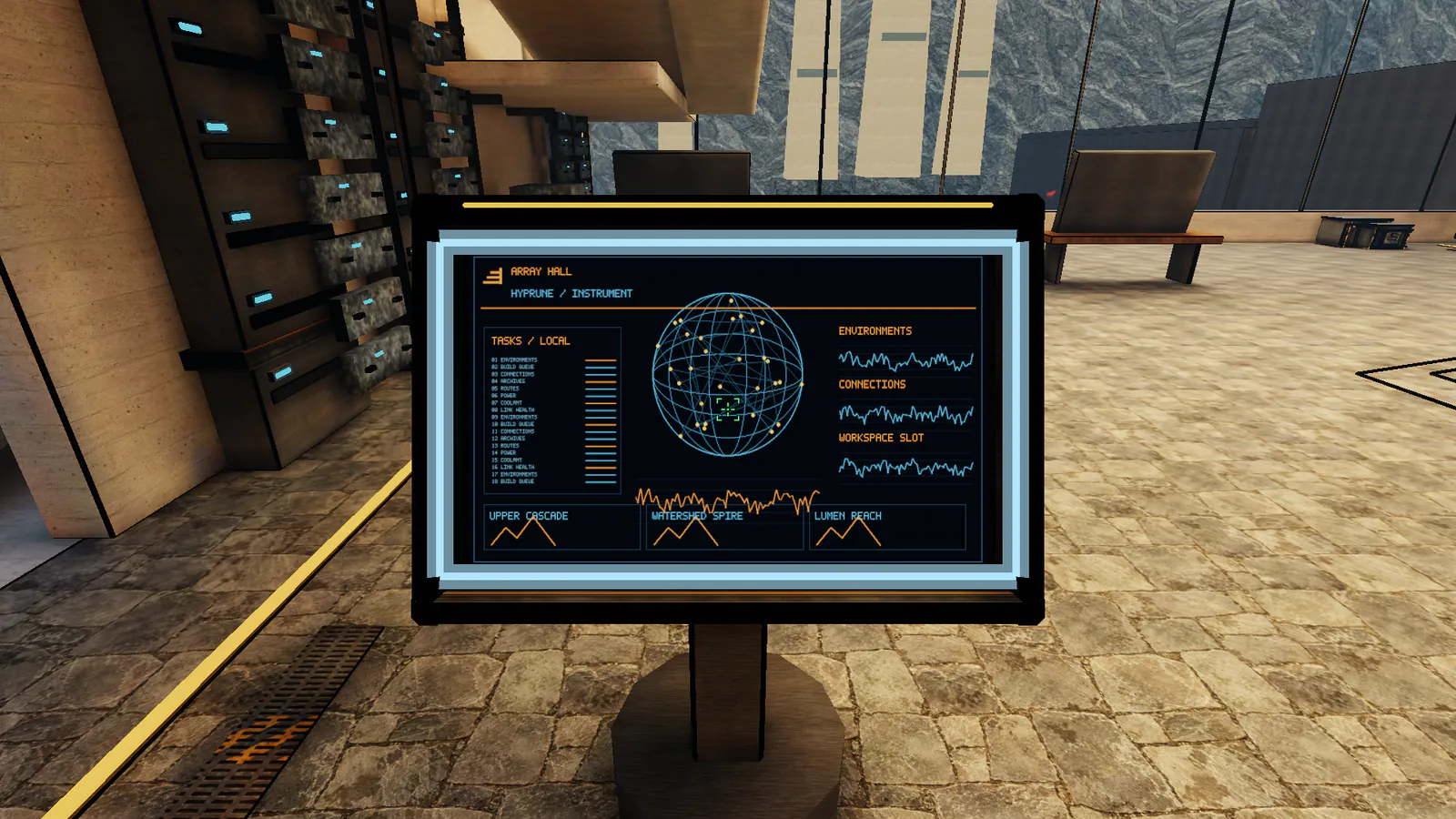
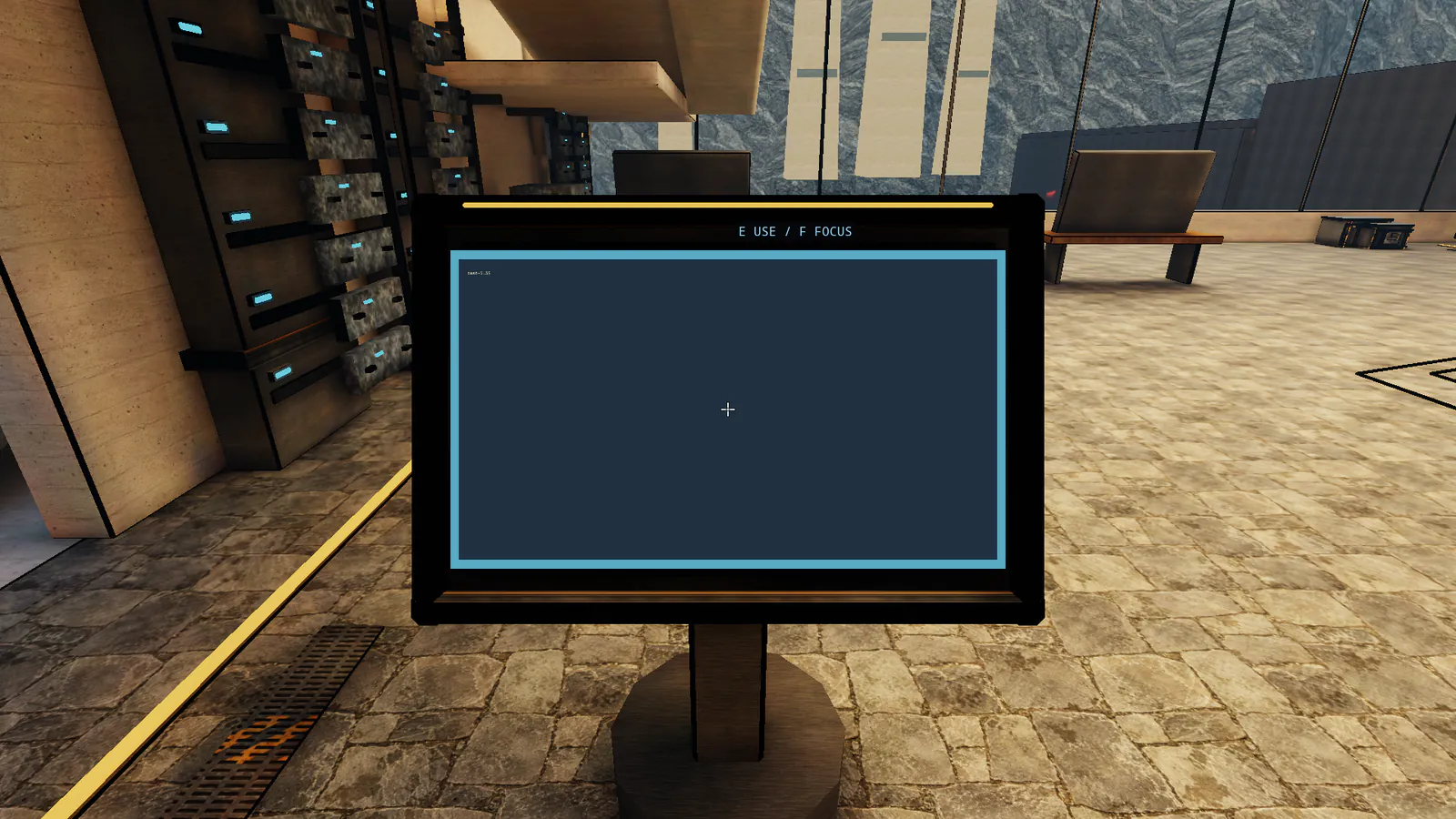
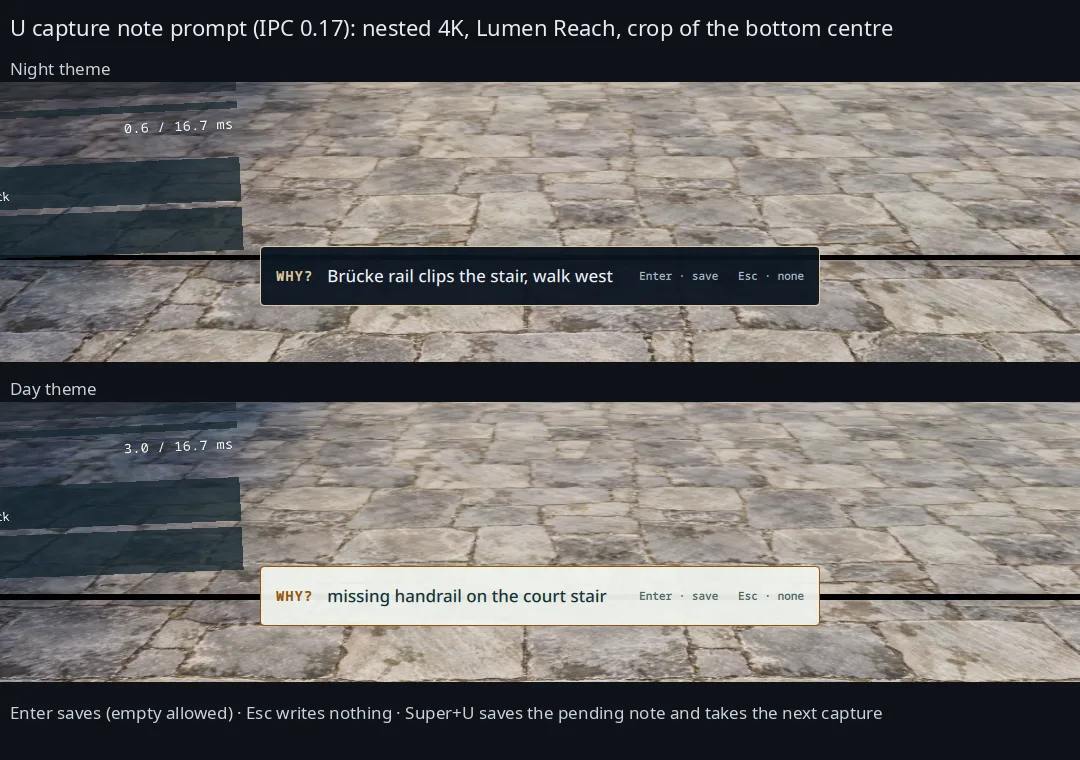
Captures got notes too (IPC 0.17). Press U in the world and the shell asks why? The note is saved with the capture and collected in one file, so a test walk turns into a readable list of findings.
A second, headless test machine with two GPUs now runs isolated nested sessions, and every night it runs every automatable suite, the schema, SDK and shell tests and the world builds. In its first day it found a render-pass tracking leak (a pass that starts and never ends after a failed frame), a daemon start-up race, GL errors wrongly blamed on world uploads, and offload refusing NVIDIA compositors and desktops without a battery. All are fixed.
Optional dGPU offload (RFC-0009, 8 October)
Section titled “Optional dGPU offload (RFC-0009, 8 October)”On laptops with a discrete GPU, a supervised Vulkan worker can render the world there and hand frames back over DMA-BUF. It runs under a power budget: 50 W / 45 FPS on USB-C or battery, 80 W / 60 FPS on qualified mains power. Phase 1 is merged and off by default. Performance → Offload switches it at runtime, and the renderer falls back to local rendering immediately if the worker stalls. At native 4K on USB-C the worker held 45 FPS at a 32.8 W peak.
The Intel iGPU already reaches 60 FPS at 4K with dynamic resolution, so offload is about quality headroom, not reaching 60. It has not been qualified on physical power profiles yet.
On 10 October offload also started working when the compositor itself runs on an NVIDIA GPU. A desktop with two RTX 3090s was tested at 1080p and 4K, both same-GPU and cross-GPU. In all five configurations offload stayed active at 60 FPS. IPC 0.18 picks the offload GPU: by default an NVIDIA GPU that isn’t driving the display, then the least busy. It also scales the power cap to that GPU. Without a battery the cap is 75% of the GPU’s enforced power limit; laptops keep the 50 W / 80 W profile ceilings.
Timeline
Section titled “Timeline”Times are CEST (UTC+2). Contract versions link to their schema reference pages.
Wednesday 7 October: foundations
- 18:57–19:17Schemas, RFCs and this site
IPC 0.1 and world format 0.1 with a validator; RFC-0001 to 0008; the organisation profile and the first version of hyprune.com.
- 19:07–19:36Core M0: a safe place
Exact-version Hyprland plugin, the
hypruneddaemon, a GLES renderer, an original room, free flight, the emergency exit and a guarded nested test harness. - 19:29–19:40SDK 0.1
A typed IPC client, a mock daemon and the
hypruneCLI to validate, pack and scaffold. - 19:31–22:40Switchyard test world
A six-dock transit world with a PBR trim library and a vaulted terminal.
- 20:12–21:05The shell begins
A validated IPC bridge, the Director, the HUD and warp transitions between places.
- 20:34–21:36Materials and navigation
IPC 0.2 and world format 0.2: camera, waypoints, travel and autodrive; PBR materials and UV1 lightmaps.
- 21:41–22:09First real session
Core, the Quickshell shell and Switchyard together over authenticated IPC 0.3.
- 22:57–23:41Workspace homes
IPC 0.4 and world format 0.3: areas, typed mounts and placement volumes; alpha sorting, bloom and reflections.
- 23:21–02:12Lumen Reach is built
Sun Court, Array Hall, Rime Vault and Signal Rise, each a workspace home, connected into one settlement.
Thursday 8 October: hands-on, first releases, offload
- 08:10–09:42Hands-on interaction
IPC 0.5: tools, carrying windows and custom placement, with desktop handovers deferred out of the render pass.
- 10:35–12:36Keymap v2
IPC 0.6 and the input schema: up to three bindings per action, live reload, crouch, and Settings in the shell.
- 12:54–12:56Starter kits and installers
Nix flake, NixOS and Home Manager modules, three kits and an Arch installer.
- 12:56Lumen Reach 0.4.0 and Switchyard 0.1.1
The first official world packages.
- 13:17–15:44Supervised live testing begins
Swap-in and panic tooling for real sessions, and the first fixes from them: window adoption and native desktop interaction.
- 16:31–18:48Live rounds two and three
Carry orientation, capture timing, overlays rendered in core, bounded 4K frame work, and dynamic render scale: the change behind 60 FPS at 4K on the iGPU.
- 20:47–21:51Graphics presets
IPC 0.7 and IPC 0.8: Low/Medium/High/Ultra and auto with GPU timings, hold timing, and a responsive Director with a curved HUD.
- 21:05–22:15Render and protocol hardening
BVH raycasts, budgeted uploads, capabilities inherited by numeric version, and a dedicated world workspace.
- 21:27Lumen Reach 0.5.0
Visual polish in every home.
- 21:32RFC-0009 proposed
- 22:46–23:41HUD concepts and the Performance page
IPC 0.9 and IPC 0.10: opt-in HUD telemetry, three curved HUD concepts and live Performance controls.
- 23:13Lumen Reach 0.6.0
Rime Vault frost and density pass.
- 23:30–23:51Climbing contracts and offload phase 1
IPC 0.11 and world format 0.4: climbable volumes. A supervised offload worker with local fallback is merged, off by default; shader warm-up and a program-binary cache.
Friday 9 October: playable, faster, smaller
- 00:03–00:54Recording, replay and free cursor
IPC 0.12: deterministic input and camera recordings; climbing merged; Super+Tab or Back for a real cursor.
- 00:08–00:40HUD legibility
Solid text and contrast that holds on bright worlds.
- 02:17–03:34Ink, visibility and the photo camera
IPC 0.13, IPC 0.14 and world format 0.5: authored outline style with quality tiers, visibility regions and an authoring photo camera.
- 04:27Lumen Reach 0.6.1
The first release on world format 0.5.
- 09:57–10:08Tool slots and the pocket
IPC 0.15: shared Primary/Secondary/Alternate/Cycle bindings and the Placement tool's pocket queue.
- 13:32–15:46Recovery from live testing
A multi-world launcher; the shell survives invalid frames and renews its credentials without dropping the session.
- 14:25–15:42Playable bounds
world format 0.6: where the camera may fly.
- 15:53Lumen Reach 0.7.0
Closed sky dome, any-angle checks and full route traversal.
- 17:44–18:24World-derived workspace homes
The world room is workspace 20 and each area's home is 20 + its slot.
- 17:48–19:50Render on demand and FSR 1
Static scenes stop rendering (compositor GPU 42% to 1%), memory and CPU work, and FSR 1 as the default upscaler.
- 19:21–20:16Compressed assets
world format 0.7: KTX2 textures, meshopt compression and quantised meshes.
- 19:38Lumen Reach 0.7.1
Fixes from the first live walk of 0.7.0.
- 20:46–21:24A refreshed site
The version-aware schema reference, a progress page and RFC-0001 to 0009 accepted.
- 22:59–23:39A new identity
The Hyprune logo and app icon across the site and shell, and an optional watermark for saved captures.
- 23:08Lumen Reach 0.7.2
A walkable, clear roof route.
Saturday 10 October: compressed release, feel, a second test machine
- 00:06–01:21Upscaler choice and shader work
IPC 0.16: FSR 1 or bilinear. Shaders compile in parallel with the upload (51 to 31 ms) and the world shader is specialised per preset (21% faster on Intel Low).
- 00:25–11:04Derived visibility
Visibility regions generated from the navmesh and scene instead of written by hand.
- 11:05Lumen Reach 0.8.0
The first release on world format 0.7: 41% smaller, 45% less GPU memory, same frame time.
- 11:15–13:54Autodrive on stairs, idle fix, stacking order
Autodrive walks routes like the player; walls recompose only when their windows change (idle GPU 2% to 0.07%) and follow Hyprland's stacking order.
- 13:45Lumen Reach 0.8.1
A Rime Vault ceiling slot no longer shows sky.
- 15:22Lumen Reach 0.9.0
Derived visibility at build time, per-area playable volumes, walking-only backstops and canonical areas.
- 15:42–15:52Shared version helpers
Schema, SDK and shell derive their protocol lists from the schema directories instead of hand-kept lists.
- 15:52–16:31Capture notes
IPC 0.17: after U, the shell asks why and saves the note with the capture.
- 17:23–17:30Fixes from the 0.9.0 live walk
World geometry is static to gestures, windows can be carried from behind, empty walls show the wallpaper or a placeholder, and placed windows snap into tool mounts.
- 19:27–20:47Frame pacing and wall clarity
Ticks follow presented frames with their real time, targets pace evenly, and walls render at native resolution.
- 19:45–21:31A second test machine
A headless two-GPU machine runs isolated nested sessions. It found and fixed a render-pass tracking leak, a daemon start-up race and misattributed GL errors.
- 21:21–22:32Offload on NVIDIA
Offload works when the compositor runs on NVIDIA, same-GPU or cross-GPU; IPC 0.18 picks the offload GPU and scales the power cap to it.
- 22:21–23:03Player settings and the reticle
IPC 0.19: field of view, walk and run speed, reach limits, view bob and a contextual reticle in six styles.
- 22:24–22:55Grab stall fixed
Starting a carry from behind: 239 ms to 0.16 ms.
- 22:39–23:41Nightly regression
Every automatable suite, the schema, SDK and shell tests and the world builds run each night on the second machine.
Sunday 11 October: fixes from testing
- 01:17–01:30Room windows at their docks
Windows that exist when a world loads take their authored docks instead of waiting in the pocket.
- 01:31Lumen Reach 0.9.1
Fixes from live testing: 16:9 primary walls, signs clear of roofs, rooftop rails and a shading fix.
- 01:38Black-pixel shader fix
Guards against invalid values in the world shader: at a tester's pose, black pixels dropped from 7,800 to 5. Found by replaying the tester's capture pose.
- 03:51–04:44Second nightly round
Stale test harnesses brought current and an unreachable roll gesture removed.
- 11:39–12:39Clean rebuilds, then the repositories go public
Switchyard 0.1.2 and Lumen Reach 0.9.2 are rebuilt from cleaned sources. The same day every Hyprune repository becomes public on GitHub.
- 13:00–17:00Blueprint maps and pocket actions
IPC 0.20: per-level blueprint maps generated from each world's geometry, and putting windows in the pocket and taking them out from the Director.
- 15:10World format 0.8
- 18:41Lumen Reach 0.10.0 released
The Sun Court armillary is now a placed world object: the globe turns slowly and its three rings spin, matched to the 0.9.2 look (per-region colour difference under 1 ΔE).
- 22:02Lumen Reach 0.10.1 released
Array Hall is an enclosed hall: walls on the east, south and west rise into the roof beams, with doors where routes pass; the north panorama stays the open view.
- 23:46–01:02Machines prototype
Placed objects driven by data: five deterministic simulators (CI, queue, server rack, deploy, build) move jobs through machines in the world.
Monday 12 October: objects, quests, residents
- 00:16–01:50Gizmo 2.0
The position tool (tool 4) gets move, rotate and scale handles in perspective, drawn anti-aliased at native resolution, with placement rules, previews and undo.
- 00:40Lumen Reach 0.10.2 released
Array Hall's new enclosure walls take the hall's own detailing: the south wall gains the side walls' ribs, trim collars and dark metal lintels, with the main screen bay recessed so its approach stays clear.
- 00:58–01:30Quests and markers
IPC 0.21: tapping TAB shows waypoints and markers for a moment, holding it opens the Director. hypruned runs personal quests and focus sessions.
- 04:12–05:04Object catalog
IPC 0.22: installed libraries form an object catalog. Objects come out of the pocket with tool 5 and are saved as user placements.
- 09:45–11:33No catalog hitches; objects in offload
A watch that rescanned the catalog every 1.2 s and costly aiming caused stalls: on the catalog demo at 1080p60, frame gaps over 25 ms fell from 177 to 13–28 and p99 from 114.6 to 21–23 ms. The offload worker now draws world objects.
- 10:09Only the room floats
Windows on a home's wall stay tiled when you leave focus; a window moved into the world goes to the room.
- 12:40Path tool
Tool 3 picks path points under the reticle: drag, insert, delete and undo. Paths are drawn only while the tool is out.
- 13:30Hyprune-starter 0.1.0 released
The first official object library: the Sun Court armillary, four ambient residents (character objects; placeable once NPCs land in the world format) and five live machines (CI conveyor, queue stack, server rack, deploy lift, build monitor) with the job token they carry.
- 14:22–17:43Residents
World format 0.9 and IPC 0.23: characters walk authored paths, stop, sit on seats, step aside and guide you. The offload worker draws them too. Core 0.5.0 ships it.
- 14:30Lumen Reach 0.10.3 released
The Sun Court plaza is plain paving: the dark expansion seams and the bent inset route rails are gone (1,492 fewer visible triangles, same draw calls).
- 16:06Core 0.4.0: prebuilt core
Each core tag now publishes a build for Hyprland 0.56.2 with its ABI hash. Try it uses it when your Hyprland matches, so there is nothing to compile.
- 20:00–22:07Gauges
A tube that fills with liquid, an abacus of 100 beads and a cube of 100 voxels show any value from 0 to 100. A script feeds each one its value, display text and label; core keeps a running average, shown as a white ring. A placed machine reads the data source named after it, with no bindings file.
- 21:46Hyprune-starter 0.1.1 released
Residents' textures stay GPU-compressed (UASTC base colour and normals): 16 MiB instead of 64 MiB for all four, closer to the lossless originals
- 22:27–23:20Data sources in the Director
IPC 0.24: Objects → Placed shows a gauge's inputs with live values and edits its command and interval, with Test, Save and Restart, and no world reload.
Tuesday 13 October: residents, gauges, releases
- 00:19Machines in offload
The offload worker draws machine state (fills, beads, labels), so a placed gauge no longer forces local rendering.
- 01:17Wrapped captions, hidden residents
Say lines wrap over up to four lines. A resident hidden behind a wall is neither drawn nor keeps frames coming; at rest in Rime Vault the frame rate drops to 0.
- 02:00–04:35Companions
IPC 0.25: pick a companion character from an installed library and it follows you through any world, catches up after a warp, keeps out of the way of your screens and talks when you press E. Put it, or any character you placed, on a drawn path by binding it with the path tool or carrying it there. Core 0.7.0.
- 03:05Lumen Reach 0.11.0
Residents in the world: one per area on its own route, with a vista, a stop by a screen and a bench where it sits. Crimson marks the way to Rime Vault and Ember walks you to Signal Rise.
- 03:16Hyprune-starter 0.2.0 released
Three gauges (tube, abacus, voxel cube) fed by scripts, with a running-average ring and gold, orange and red states
- 03:25Core 0.6.0
Data sources, gauges, machines in offload, wrapped captions, hidden residents at no cost and GPU-compressed character textures, with a prebuilt for Hyprland 0.56.2 that Try it installs.
- 04:45Registry, phase 1
RFC-0015: official, community and labelled custom sources; install, update, roll back, pin and remove with every download checked against its hash, from the SDK's command line and the Director's Library page. The installers preinstall the pinned libraries.
- 09:11–11:25Smooth demo cameras
Demo recordings use a camera driven by core: keyframed tracks on smooth curves and follow shots, written out through a frame export path that records every presented frame. Demo films no longer stutter the way screen captures did.
- 09:13Characters move whenever the world is shown
Residents and the companion no longer pause on battery, when you stop moving, while you type or in the free cursor; they pause only while the world is inactive or covered. Motion still, off and reduced motion are how you stop them, and a request they can't carry out is refused with the reason. Render on demand and the hidden-resident test keep the cost to characters in view.
- 10:25–13:17Live offload pacing
With offload on, the worker hands the compositor one fresh frame per frame in a live session; at 60 Hz a quarter of frames used to repeat. Frame pacing now matches rendering in the compositor.
- 10:26–10:35Ghost windows fixed
Every window on the room and home workspaces gets a record. Past the old cap of 16 records, new windows opened invisible and could not be pocketed. A closed window is now dropped at once, also while another is in focus.
- 11:22–13:37Steering, avoidance and gait
RFC-0010 amendment: characters steer round each other, take detours round placed objects and pillars, and stop in front of a screen just outside its approach zone. Their feet keep in step with their speed, without sliding. The companion eases its pace and can walk or run with you.
- 14:12Core 0.7.2
No-cap window records, characters that move whenever the world is shown, steering and gait, demo cameras, live offload pacing and a demo source for newly placed machines, with a prebuilt for Hyprland 0.56.2 that Try it installs.
- 17:21Lumen Reach 0.11.1
Fixes from live testing. Surfaces that met flush (tiles, decks, beams, screen frames) no longer flicker: the build removes hidden faces and steps the rest back, and a new check covers every plane in the world. The valley floor below the settlement edges is in daylight instead of reading as black glass, and residents stop in front of the screens they look at.
- 17:40Debug tool on the wire
IPC 0.26: shells see the debug tool (key 9) and its layer, legend and info card; the companion's walk or run pace is part of its state and can be set from Settings → Companion; the Director lists every pocketed window, up to 128.
- 18:00Core 0.8.0
IPC 0.26 in a release: the debug tool, the companion's pace and the whole pocket list, with a prebuilt for Hyprland 0.56.2 that Try it installs. SDK 0.10.0 and schema 0.12.0 carry the same contract.
- 20:50Core 0.8.1
Fixes from the Lumen Reach 0.11.1 live notes and the queue: offload draws the companion and anything from a library installed mid-session; the waypoint line lies on the ground and its route goes round hills and buildings (RFC-0004 amendment); arriving clears the waypoint (RFC-0012 amendment); marker labels at 4K; characters use their own names; Recall spreads windows out. No wire change; Try it installs the new prebuilt.
Wednesday 14 October
- 01:40Lumen Reach 0.11.2
The valley below the settlement was plain grey rock under a hard edge across the painted horizon. Now the terrain carries the panorama itself: from the Sun Court and the Array Hall its forests, cliffs, waterfalls and cloud sea run on below the edges, and the rim shows the painting it covers, so the seam is gone. The slopes and cliff under the plinths stay rock. Same frame times as 0.11.1.
- 02:00Core 0.8.2
Fixes: a GPU that enforces less than 20 W no longer trips the offload power cap; new characters upload over several frames, so spawning a few no longer hitches; the reticle hint and route checks use the collision index; characters from older exporters (specular-glossiness materials) keep their colours; X11 menus stay with their own app instead of the focused window. No wire change; Try it installs the new prebuilt.
- 13:30Core 0.8.3
Fixes: after a screen lock or the display turning off, the HUD comes back (the shell could not take its screen again); spawning a character in front of you finds open floor past the areas reserved for windows, and a refusal says why; the E USE / F FOCUS prompt hides while you use a window. No wire change; Try it installs the new prebuilt.
- 17:45Core 0.8.4
Fixes: a character you placed can be set down on a path you drew with tool 3 (or rebound to it from Director → Objects), which then becomes its route; your companion no longer stands idle far away when you stop where there is no free spot near you (the foot of the Signal Rise ramp); with offload, steam behind a character no longer draws over them. No wire change; Try it installs the new prebuilt.
- 22:00Workspace screens
IPC 0.27 (draft) and object format 0.11: place a screen anywhere, 16:9 or 21:9, on a wall or on a stand, and it shows a workspace live like a home wall, on the next free workspace or the one you choose. Windows there stay tiled, F flies in and selecting the workspace travels to the screen.
- 23:30Import a model from the Director
Objects → Import… turns a glTF, GLB, OBJ or FBX file into an object without Blender: it guesses the units and shows the size to confirm, turns Z-up models upright, simplifies to a triangle target, shrinks and compresses textures, builds a collision shape and a thumbnail, and records the licence, author and source you give it (or none). Big models import with warnings instead of refusals.
- 23:50Build your own world
Director → Builder → Build: name a world and it opens as a big flat plain under a sky you can change, in a folder of its own. Place your imports, workspace screens and library objects; they are copied in, so the world keeps working wherever the folder goes. Save keeps a version with an optional message; Release gives it a version number, and with a GitHub repository it publishes the release in the registry format. World format 0.11 (draft) adds panorama skies.
- 23:51Lumen Reach 0.11.3
Walking, running or autodriving past the foot of the Signal Rise snow-service stairs could drop you through a slot in the floor, one walker wide, into the valley. The floor is closed now, and a sweep of every wall, railing and floor edge with the engine’s own walker (walk, run and autodrive at five angles) found and closed the other places a walker could leave the world: the Sun Court’s west rail runs on under the West lookout, the hall’s upper flight has a railed foot landing, and invisible guards close the rest, roofs you can only fly to included. The sweep is now a release gate. Same frame times as 0.11.2.
Thursday 15 October
- 00:49Core 0.9.0
The builder track is released: IPC 0.27, world format 0.11 and object format 0.11 are final in @hyprune/schema 0.13.0 and SDK 0.11.0. Workspace screens you place anywhere, models imported from the Director, and your own world folders with panorama skies come out of draft. Also: user characters bound to a route survive a restart, and
hyprune-walk-checklets world tools sweep walls and floor edges with the engine’s walker. Try it installs the new prebuilt. - 03:50Core 0.9.1
Gauges read web APIs: the source helper polls HTTP sources with any method and body, finds secrets by name in a 0600 file or your keyring, and maps a response to a gauge’s value, colour and text with JSONPath-like paths. Director → Objects → Data sources edits every source and shows the raw response beside what would publish. Feed a gauge from a web API; Try it installs the new prebuilt.
- 06:37Core 0.10.0
The shared clip library: a walk, a sit or a dance made on one character plays on every character with the same skeleton, retargeted to its body when it loads. Pick a walk, run and idle style per character and for your companion; companions dance when asked. Floating walks come down to the ground. IPC 0.28 and motion packs are final in @hyprune/schema 0.14.0 and SDK 0.12.0; Try it installs the new prebuilt.
- 06:59–07:32Starter kit 0.3.0 and the first companions
The starter kit gains four workspace screens, a wall bezel and a stand at 16:9 and 21:9: place one and it shows a workspace of its own. Its 30 starter motions give every character styled walks, runs and idles and a new upright sit, which the residents now use. The optional Hyprune companions library brings Muse, Ember and Starlit, who follow you through every world and dance from their own pack of fourteen dances.
- 08:28Lumen Reach 0.12.0
The residents sit like people: they take the starter kit’s shared sit, seated idle and stand-up, which the world now carries, and core 0.10.0 retargets them onto each resident. On the Sun Court and hall benches they sit upright on the seat, legs crossed, instead of hunching on the front edge, and their walks no longer float. Same frame times and budgets as 0.11.3; needs core 0.10.0 for the sit.